INSTITUTE FOR INTERNATIONAL RESEARCH, INC. (IIR)
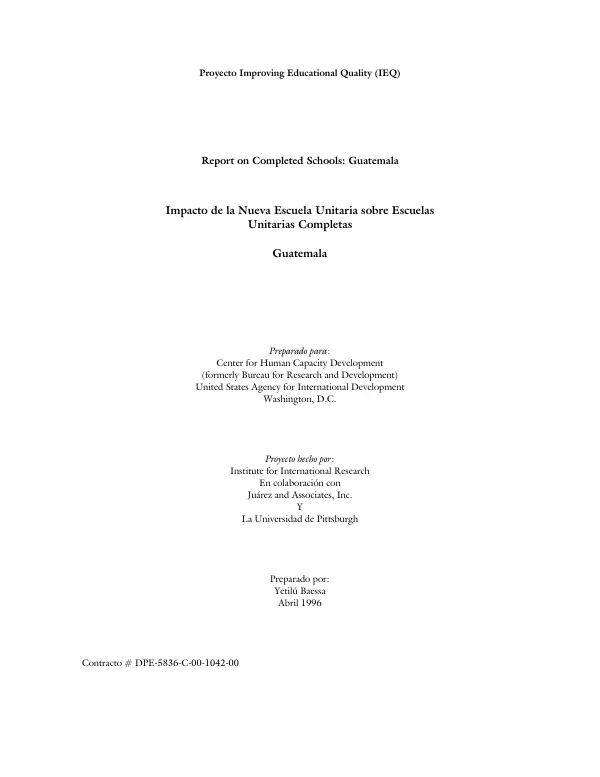
Research report -- phase I : improving educational quality project -- Guatemala
Summarizes Phase I and Year 2 reports on the implementation of Nueva Escuela Unitaria (NEU), an innovative learning program for rural multigrade primary schools in Guatemala.
de Baessa, Yetilu; Giron, Rosa Y. · 1994
Sign in to readA free account is required to download.
Abstract
NEU is based on active learning principles that stress collaborative learning, peer teaching, use of self-insturctional guides, and the like. NEU is being implemented in two regions, one with a predominatly indigenous population, the other with a nonindigenous or Ladino population. The results in the first year, based on tests of student achievement combined with focused observations of children in the classrooms, show that the program was successful in decentralizing education by encouraging children"s participation in small group contexts. Significant correlations were found between participation in small group learning contexts and academic achievement of first and second graders in Spanish and Mathematics among children in the NEU program. The nature of the small groups however, differed in terms of the Spanish language proficiency of the children. Little relationship was found between the learning contexts and academic achievement in traditional rural schools that served as a comparison group for the study. Implications of the results for social constructivist theory and approaches to rural education are discussed. Follow-up research was conducted a year later with second and third graders. The study compared 10 NEU schools and 10 comparison schools, using the same students who had been tested as first and second graders the year before. Key findings were as follows. (1) The NEU program"s greatest impact in its second year of complete implementation was on the socio-emotional behavior of participating children, who performed significantly better than those in the comparison schools on the creativity measure, and cooperated with their peers, guided other students, and participated in school government more than students in traditional schools. These behavioral changes were transferred to home and community life and appear to result from the teaching strategies used by the NEU program and the quality of the interactions that take place in the classroom. The NEU schools used a greater variety of learning contexts than did traditional schools. NEU students spent a significant part of the day in small group activities, working in pairs, using learning corners, etc., while students in traditional schools spent most of their day working on individual assignments at their seats or receiving dictation from the teacher in a large group. When interacting with teachers, materials, or peers, NEU students were encouraged to expand responses, use their imaginations, and ask questions with greater frequency than children in traditional schools. (2) The NEU program has had a significant effect on retaining children in school, with desertion rates for both girls and boys significantly lower than in comparison schools. Higher enrollment rates than in traditional schools suggest that the program may also be encouraging dropouts to return to school. (3) The changes in socio-emotional behavior and in classroom environment found in the program have not translated into consistently higher gains in achievement. The achievement gains that generally favored NEU children after one year were less clear after 2 years of schooling, apparently due to the inability of NEU second and third graders to use the self-instructional guides effectively in small groups without the teacher present. Their limited reading ability forces them to use learning strategies similar to those used by children in traditional schools, such as asking directions from the teacher, and copying material. (4) The NEU program is having an effect on the performance of girls. Girls attending NEU schools had significantly higher scores on the creativity measure than did girls in the comparison schools. The performance of girls is in fact primarily responsible for the significant differences in creativity favoring NEU found for the total sample. The observational findings also show that the NEU program is encouraging cooperation among indigenous children of both sexes.