USAID DEC
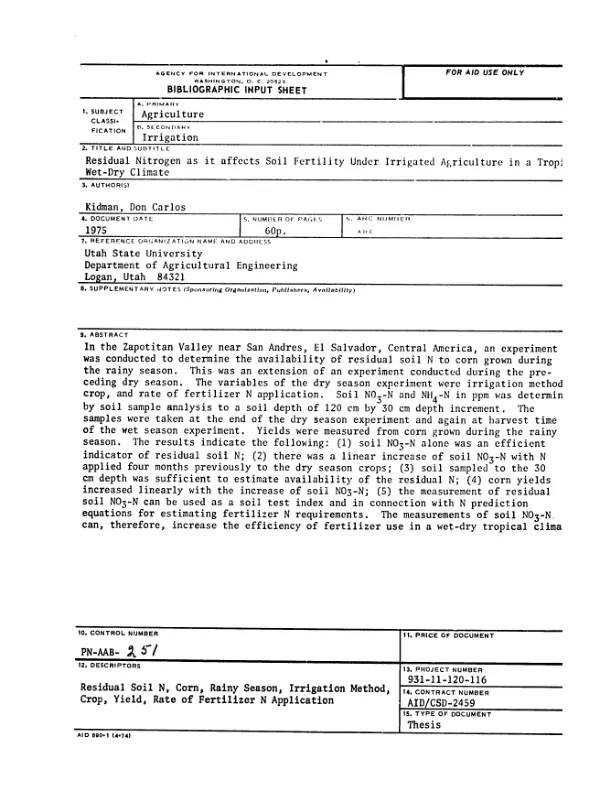
Residual nitrogen as it affects soil fertility under irrigated agriculture in a tropical wet - dry climate
Sign inUTAH STATE UNIVERSITY
Residual nitrogen as it affects soil fertility under irrigated agriculture in a tropical wet - dry climate
In the Zapotitan Valley near San Andres, El Salvador, Central America, an experiment was conducted to determine the availability of residual soil N to corn grown during the rainy season.
Kidman, Don C. · 1970
Sign in to readA free account is required to download.
Abstract
This was an extension of an experiment conducted during the preceding dry season. The variables of the dry season experiment were irrigation method, crop, and rate of fertilizer N application. Soil NO3-N and NH4-N in ppm was determined by soil sample analysis to a soil depth of 120 cm by 30 cm depth increment. The samples were taken at the end of the dry season experiment and again at harvest time of the wet season experiment. Yields were measured from corn grown during the rainy season. The results indicate the following: (1) soil NO3-N alone was an efficient indicator of residual soil N; (2) there was a linear increase of soil NO3-N with N applied four months previously to the dry season crops; (3) soil sampled to the 30 cm depth was sufficient to estimate availability of the residual N; (4) corn yields increased linearly with the increase of soil NO3-N; (5) the measurement of residual soil NO3-N can be used as a soil test index and in connection with N prediction equations for estimating fertilizer N requirements. The measurements of soil NO3-N can, therefore, increase the efficiency of fertilizer use in a wet-dry tropical climate.
Connected topics
Related documents
Documents in this collection
 1970
1970USAID DEC
Effects of selected herbicides on perennial grasses and water pollution under tropical high rainfall conditions
Open record 1970
1970USAID DEC