USAID DEC
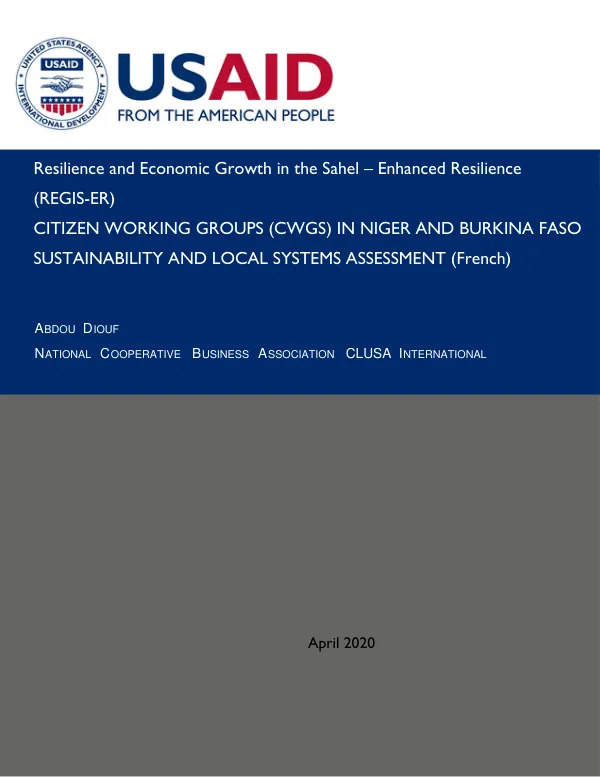
Resilience and Economic Growth in the Sahel – Enhanced Resilience (REGIS-ER) Sustainability and Local Systems Assessment
Sign inUSAID
Resilience and Economic Growth in the Sahel – Enhanced Resilience (REGIS-ER) Sustainability and Local Systems Assessment
The REGIS-ER project, funded by the U.S.
2020 · 43 pages
Sign in to readA free account is required to download.
Abstract
Agency for International Development (USAID), aims to enhance resilience in vulnerable populations in Burkina Faso and Niger. The project focuses on improving food security, nutrition, and economic well-being through three main components: sustainable economic well-being, strengthened governance, and improved health and nutrition. REGIS-ER has been implemented since 2013, with a focus on consolidating the capacities of local institutions, including citizen work groups (CWGs), to ensure their effective functioning and access to reliable funding sources. The project has made significant progress in strengthening local governments and communities, promoting autonomy, and reducing the need for long-term assistance. Citizen work groups (CWGs) are at the heart of REGIS-ER's governance work, acting as a bridge between village development committees and municipal councils at the commune level. They provide a means to address needs and resources, facilitating the coordination and implementation of resilience initiatives. The study aims to evaluate the operational effectiveness and impact of CWGs and their perspectives on sustainability within the local governance system. In other words, it seeks to document the effectiveness of CWGs in coordinating and implementing resilience initiatives. The study focuses on assessing the capacity of CWGs to address the needs of vulnerable populations, their ability to access resources, and their potential for sustainability. The study's methodology involves a comprehensive review of existing documents, the development of tools for data collection, and field data collection through interviews with key stakeholders, including CWG members, municipal councilors, and local government officials. The study also involves the analysis of data from CWG activities, including their impact on food security, nutrition, and economic well-being. The study's findings highlight the importance of CWGs in promoting resilience and addressing the needs of vulnerable populations. CWGs have been effective in coordinating and implementing initiatives to improve food security, nutrition, and economic well-being. However, the study also identifies challenges and obstacles to the sustainability of CWGs, including limited resources, inadequate capacity, and lack of institutional support. The study's conclusions and recommendations emphasize the need for continued support for CWGs to ensure their sustainability and effectiveness. The study suggests that CWGs should be integrated into the local governance system, with clear roles and responsibilities, and access to reliable funding sources. The study also recommends that CWGs should be empowered to take ownership of their activities and decisions, with a focus on promoting autonomy and reducing the need for external assistance. The study's findings and recommendations have implications for the REGIS-ER project and other initiatives aimed at promoting resilience and addressing the needs of vulnerable populations. The study highlights the importance of CWGs in promoting resilience and addressing the needs of vulnerable populations, and emphasizes the need for continued support and empowerment of CWGs to ensure their sustainability and effectiveness.