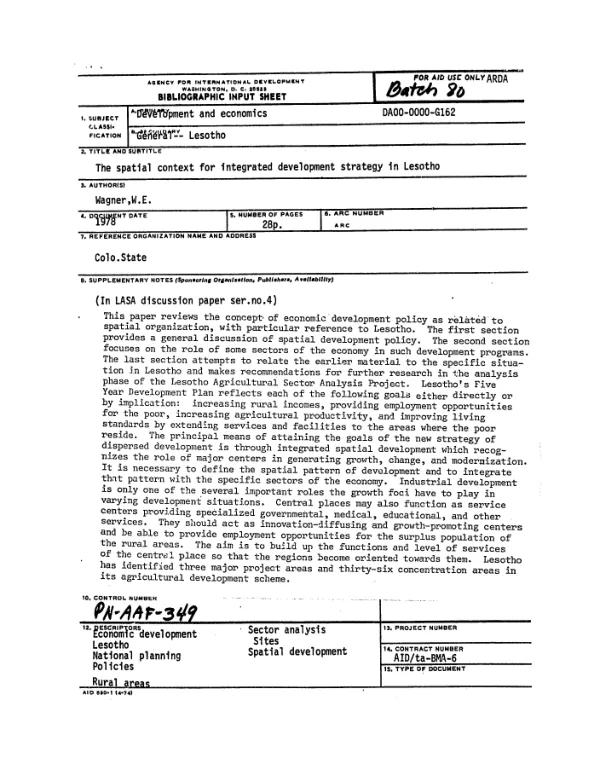
COLORADO STATE UNIVERSITY
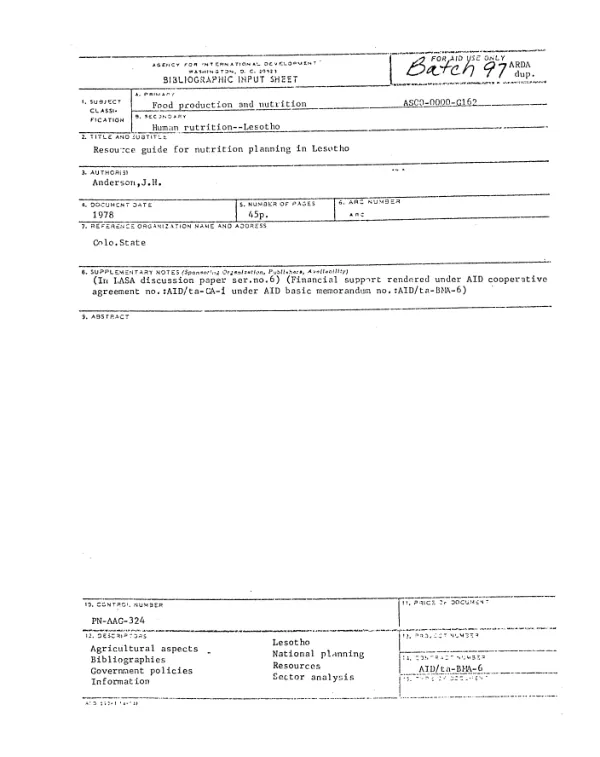
RESOURCE GUIDE FOR NUTRITION PLANNING IN LESOTHO
Report focuses on food production, agricultural policy and the nutritional health status of the population of Lesotho.
ANDERSON, J. H. · 1970
Sign in to readA free account is required to download.
Abstract
Author discusses previously compiled data and studies indicating serious nutritional imbalances in the Basotho population and presents the following overall picture: 20% of the under-five children are reported to be stunted and chronically malnourished; 25% are anemic; 13% of the mothers are obese; and 33% of the households are estimated to be without sufficient income to provide a satisfactory diet for the entire family. Author notes that if good nutrition is accepted as a basic national policy goal, three policy issues become fundamental: (1) How can the population be educated to make the best use of limited food resources? (2) How can food supplies be more equitably distributed? (3) How can food production be influenced in favor of a more nutritious pattern? The authors outline food production, food technology, marketing, nutrition education and legislation as priority areas for which data is urgently needed to formulate an effective national nutrition policy. Currently available sources of data on per capita food consumption are then dicussed -- with data too old, or as yet incomplete, specifically noted. Three nutrition data sources are recommended -- a 1977 Attitude Survey on Senqu Project Area Farmers by J. Gay and T. Guma, the 1972-74 FAO Food Balance Sheets for Lesotho, and the 1972/73 Household Budget Survey. Appended to the report are: a listing of Departments and agencies involved in nutrition activities, a bibliography of sources of information on nutrition activites in Lesotho and a sample calculation of the 1976 Average Per Capita Food Consumption Data.