USAID DEC
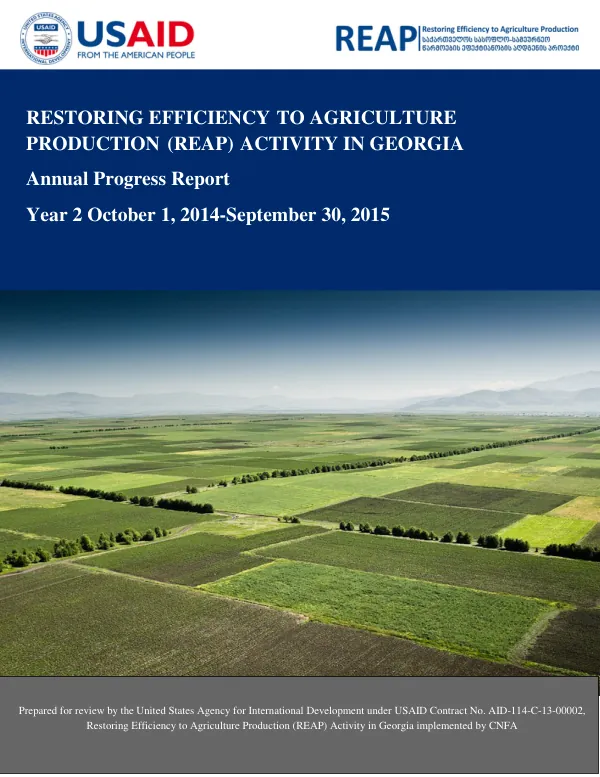
Restoring Efficiency to Agriculture Production (REAP) Activity in Georgia: Quarterly Progress Report
Sign inCNFA, INC.
Restoring Efficiency to Agriculture Production (REAP) Activity in Georgia: Quarterly Progress Report
The Restoring Efficiency to Agriculture Production (REAP) Activity in Georgia is a USAID-funded project implemented by CNFA.
2015 · 73 pages
Sign in to readA free account is required to download.
Abstract
The project aims to improve the efficiency of agriculture production in Georgia by supporting small and medium-sized enterprises (SMEs) in the agriculture sector. The project focuses on two main components: SME development and technical assistance. Component 1, SME Development, involves providing grants to SMEs in the agriculture sector to support their growth and development. The project has issued several requests for applications (RFAs) to solicit grant proposals from eligible SMEs. The RFAs include RFA 003/2014, RFA 004/0115 (FSCs/MSCs Grants), RFA 005A (APMA Grants), and RFA 005B (Processing Grants). The project has also established a grant portfolio, which includes grants for various agriculture-related activities such as food safety and quality standards, branding and labeling, and enterprise strategic planning. Component 2, Technical Assistance Program, provides training and technical assistance to SMEs in the agriculture sector. The program includes individual consultancy services in food safety and quality standards, branding and labeling, and enterprise strategic planning. The program also offers group training in veterinary practices, customer service, and DCFTA. Additionally, the program provides technical assistance to non-grantees and enhances the pool of REAP partner BSPs. The project also focuses on cross-cutting activities, including gender, access to finance, workforce development, and environmental management and monitoring. The project aims to facilitate the development of women-owned agribusinesses and establish a strategic platform for gender-equitable agricultural development. The project also provides access to finance orientation training for women-owned businesses and agricultural lending training for banks' loan officers. The project has achieved several milestones in the second year of implementation. The project has issued several RFAs and has received grant proposals from eligible SMEs. The project has also provided technical assistance to SMEs in the agriculture sector, including training and consultancy services. The project has also established a grant portfolio and has provided access to finance orientation training for women-owned businesses. The project has also faced several challenges, including programmatic constraints and key constraints. The project has identified several key constraints, including limited access to finance, lack of technical expertise, and limited market access. The project has also identified several programmatic constraints, including limited resources and limited capacity. The project has submitted several reports to USAID/Caucasus, including quarterly progress reports and annual progress reports. The project has also submitted several annexes, including a map of approved grant projects, a list of approved grant projects, and branding and labeling examples. The project has received funding from USAID under contract number AID-114-C-13-00002. The project has been implemented by CNFA, and the project has been submitted to USAID/Caucasus by Ms. Shamenna Gall, COR. The project has been submitted on October 30, 2015.