CNFA, INC.
Restoring Efficiency to Agriculture Production (REAP) Quarterly Progress Report
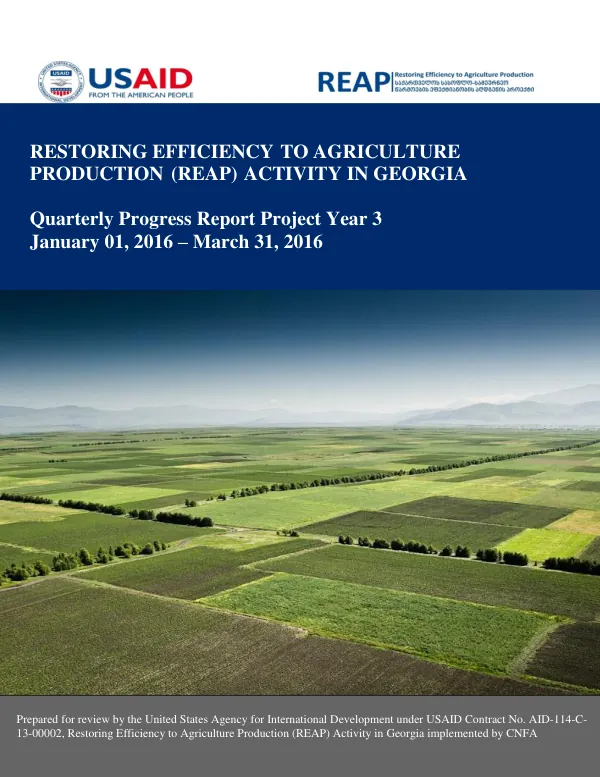
Restoring Efficiency to Agriculture Production (REAP) Activity in Georgia is a project implemented by CNFA under USAID Contract No.
2016 · 39 pages
Sign in to readA free account is required to download.
Abstract
AID-114-C-13-00002. The project aims to improve the efficiency of agriculture production in Georgia by supporting small and medium enterprises (SMEs) and promoting good agricultural practices (GAP). The project focuses on two main components: SME development in the agriculture sector and technical assistance programs. SME development is a key component of the project, with a focus on providing grants to SMEs to support their growth and development. The project has established a grant program, which has provided funding to over 70 grantees. The grantees have been supported through various activities, including training and capacity building, market linkage facilitation, and access to finance. The project has also established a business service provider (BSP) to provide technical assistance to grantees. The technical assistance program is another key component of the project, which provides support to SMEs through various activities, including individual consultancies, group trainings, and marketing support. The project has also established partnerships with various organizations, including the Agricultural Projects' Management Agency (APMA), the National Food Agency (NFA), and the Georgia Hazelnut Growers Association (GHGA). These partnerships have enabled the project to provide technical assistance to SMEs and promote good agricultural practices. The project has made significant progress in its first three years, with a focus on transitioning from grant making to technical assistance. The project has established a strong foundation for its technical assistance program and has begun to implement new and innovative approaches to support SMEs. The project has also demonstrated its commitment to grantee success, with a focus on ensuring the long-term sustainability of the SMEs supported by the project. The project has also made significant progress in its monitoring and evaluation (M&E) activities, with a focus on tracking the impact of the project on SMEs and the agriculture sector as a whole. The project has established a robust M&E system, which includes regular reporting and data collection. The project has also established partnerships with various organizations to support its M&E activities. The project has also made significant progress in its outreach and communications activities, with a focus on promoting the project's activities and achievements to a wider audience. The project has established a strong social media presence and has produced various publications, including a quarterly progress report and an annual report. The project has also organized various events, including a visit by the US Ambassador and a tour of the CAMPA facility. The project has also faced various challenges, including a lack of access to finance and a lack of market linkage. However, the project has worked to address these challenges through various activities, including the establishment of a BSP and the provision of technical assistance to grantees. The project has also established partnerships with various organizations to support its activities and has worked to promote good agricultural practices. Overall, the REAP project has made significant progress in its first three years, with a focus on transitioning from grant making to technical assistance. The project has established a strong foundation for its technical assistance program and has begun to implement new and innovative approaches to support SMEs. The project has also demonstrated its commitment to grantee success and has made significant progress in its M&E and outreach and communications activities.