USAID. BUR. FOR PROGRAM AND POLICY COORDINATION. CENTER FOR DEVELOPMENT INFORMATION AND EVALUATION (CDIE)
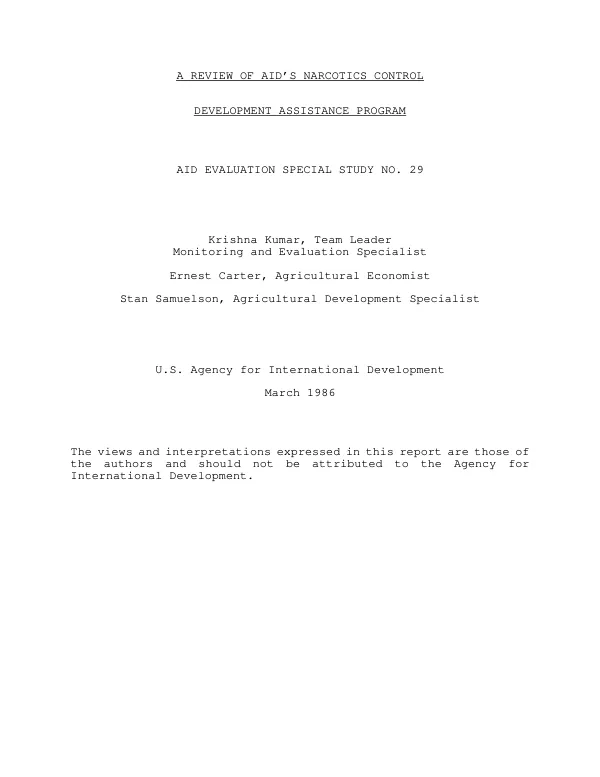
Review of AID"s narcotics control development assistance program
AID"s experience with narcotics control activities has been recent, with most projects still in the implementation stage.
Kumar, Krishna; Carter, Ernest +1 more · 1986
Sign in to readA free account is required to download.
Abstract
Nevertheless, in concert with the State Department"s Bureau of International Narcotics Matters and the UN Fund for Drug Abuse and Control, AID has played a significant role in U.S. efforts to control narcotics production and trade in several source countries. This paper reviews AID"s policy, field activities (summarizing those in Turkey, Pakistan, Thailand, Peru, and Bolivia), key issues in project implementation, and items of special interest in evaluating narcotics control projects. AID employs three major intervention strategies in development assistance for narcotics control: (1) crop substitution, or, primarily, the identification and introduction of crops to replace narcotics; (2) negotiated assistance, providing development assistance to areas where local and government officials have agreed to control narcotics production; and (3) area development (believed to be most effective), to provide new income and employment opportunities for farmers adversely affected by a narcotics control project. Impediments to the control of narcotics crop cultivation through development have included: host government inability or unwillingness to formulate long-term control programs and policies; the high profitability of narcotics crops; difficulty in reaching remote areas; faltering national economies making narcotics cultivation and trade attractive; local cultural acceptance of narcotics; and the presence of powerful trafficking organizations. It is recommended that AID: (1) pursue multidimensional area development in narcotics-producing areas; (2) design these initiatives for the long term; (3) lend greater weight to sociocultural factors significant to narcotics trade and its eradication; (4) consider giving project management staff freedom to plan and act; (5) include in each project a separate unit to mobilize the population against narcotics cultivation and trafficking; (6) initiate and support public education in potential source nations; (7) establish linkages with local law enforcement agencies; and (8) exploit project evaluations for data collection.