INTERNATIONAL CROPS RESEARCH INSTITUTE FOR THE SEMI-ARID TROPICS (ICRISAT)
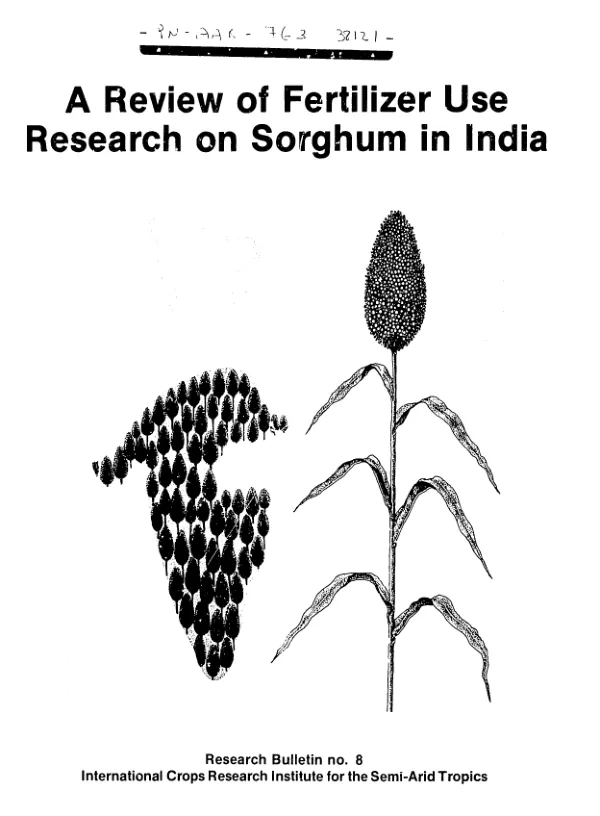
Review of fertilizer use research on sorghum in India
Sorghum, the third most widely grown crop in India after rice and wheat, constitutes the staple food of much of the population.
Tandon, H. L. S.; Kanwar, J. S. · 1970
Sign in to readA free account is required to download.
Abstract
This bulletin reviews soil fertility and fertilizer use research on grain sorghum in India since 1960, covering all nutrients, soil/climate conditions, and seasons in which the crop is grown. Following are the major conclusions of the review. Deficiencies of nitrogen (N), phosphorus (P), and zinc (Zn) are widespread under both rainfed and irrigated conditions. High-yield cultivars have shown greater responses than have local cultivars, and invariably both N and P have shown additive effect. Split application of N is generally more effective than a single dose. About 62.5% fertilizer N is recovered by sorghum from alfisols and 55% from vertisols. Drilling of phosphate is more effective than broadcasting. Potassium (K) responses can only be observed in long-term experiments. Zn responses have been reported, especially in vertisols where available Zn is with less than 1.2 parts per million. In the post-rainy season, responses to N depend on the cultivar and the nitrate-N level of the soil. The optimum N level for sorghum is 60-120 kg/ha in the rainy season, 25-85 kg/ha in the post-rainy season, and 80-150 kg/ha in the summer season. Overall, the review indicates a dearth of studies on the relationship of fertilizer responses to soil fertility and environment. Although it is shown that fertilizer use is the key to increased sorghum production, few data are available on nutrient-moisture interactions and their management. A 273-item bibliography (1960-84) is appended. (Author abstract, modified)