PRAGMA CORP.
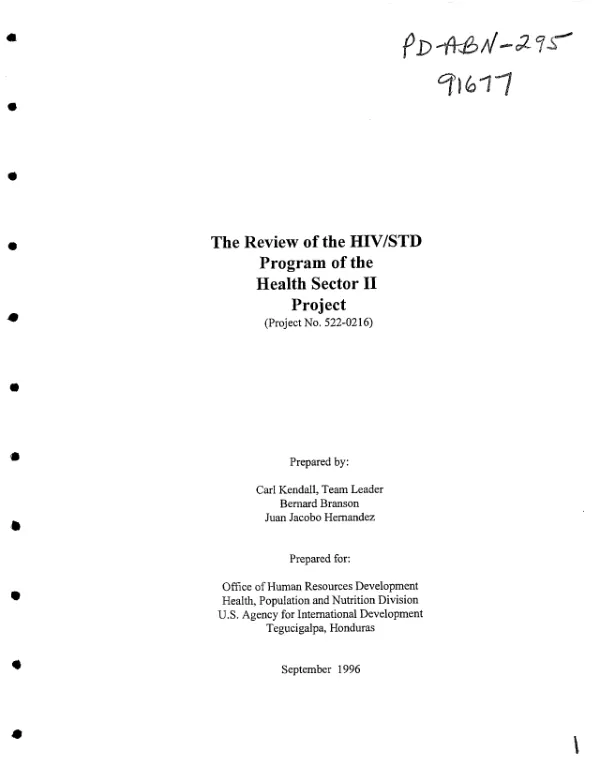
Review of HIV/STD program of the health sector II project (project no. 522-0216)
Evaluates the activities of the HIV/sexually transmitted disease (STD) program of the Health Sector II project (5220216).
Kendall, Carl|Branson, Bernard|Hernandez, Juan Jacobo · 1996
Sign in to readA free account is required to download.
Abstract
Evaluation covers the period 8/94-9/96, focusing almost exclusively on the activities of the AIDS Control and Prevention project (AIDSCAP) (9365972). It is estimated that 1996 will see the largest number of AIDS cases ever reported in Honduras. Levels of HIV infection remain high, but do not represent an explosive increase from previous years. The Ministry of Health (MOH) continues to report declining levels of syphilis and gonorrhea. The following progress has been made in STD treatment. (1) With AIDSCAP support, country norms and guidelines for syndromic STD management have been developed. (2) During this evaluation, 32 health workers from the health regions in the four project areas were trained. (3) The MOH has planned for a supply of the necessary drugs through a World Bank project, but these drugs are not yet available in the clinics. (4) AIDSCAP has initiated a study to determine antibiotic susceptibilities of STD pathogens in Honduras, but specimen collection has been slower than expected, and no results are yet available. Syndromic management will be piloted in the four STD Integrated Management Units (UMIETS), which will then serve as training resources in area health centers. The STD/AIDS Division was established in 1994, combining the MOH's STD Control and Prevention Program and the National AIDS Control Program, which was founded in 1992. The Division has a broad mandate and shrinking staff. Among its responsibilities are support to the Health Regions, developing and promulgating norms for STD treatment, surveillance, condom logistics, and health education. However, surveillance is not currently being performed, and although norms have been developed for the syndromic therapy treatments regimen and the first tranche of MOH personnel has been trained with AIDSCAP support, continued high levels of support from AIDSCAP will be required. In addition, the Medium Term Plan which served as a blueprint for the program is ending. MOH efforts have focused on awareness messages directed at the general population, but they are ambiguous in intent and unlikely to effect behavior change. AIDSCAP has been assisting the project to adopt a behavior change communication perspective and should continue to do so. The first year of the project has been very successful. NGOs have been identified and trained, and financial and administrative reporting is in place guaranteeing the appropriate use of project funds. STD norms, treatment guidelines, and training materials have been developed with the MOH; training is underway; and efforts in quantitative and qualitative research will produce data to develop communication interventions by the NGOs. Developing, funding, and monitoring of the 10 subagreements with the implementing agencies is an enormous achievement. USAID, through support to AIDSCAP, is one of the only donors in-country that actually closely monitors each subproject. AIDSCAP has maintained excellent working relationships with the MOH, USAID, and other donors. The MOH and other donors perceive AIDSCAP to be an essential element in their response to the epidemic. The NGOs report having been strengthened by AIDSCAP and are overwhelmingly supportive of its efforts. All NGO subprojects should be continued for at least the next year. The NGOs selected have different strengths; one may have strong relations with the target populations and another a strong health education staff. But all NGOs have been involved in all intervention areas, such as development of health educational materials for different target groups. AIDSCAP should be permitted to build on strengths and selectively develop the NGOs. NGOs have requested closer supervision from AIDSCAP, recommending that a satellite AIDSCAP office be created on the North Coast of Honduras. This is a good suggestion and thought should be given to either moving staff to the North Coast or recruiting an additional staff person to provide support to projects in San Pedro Sula and La Ceiba.