USAID DEC
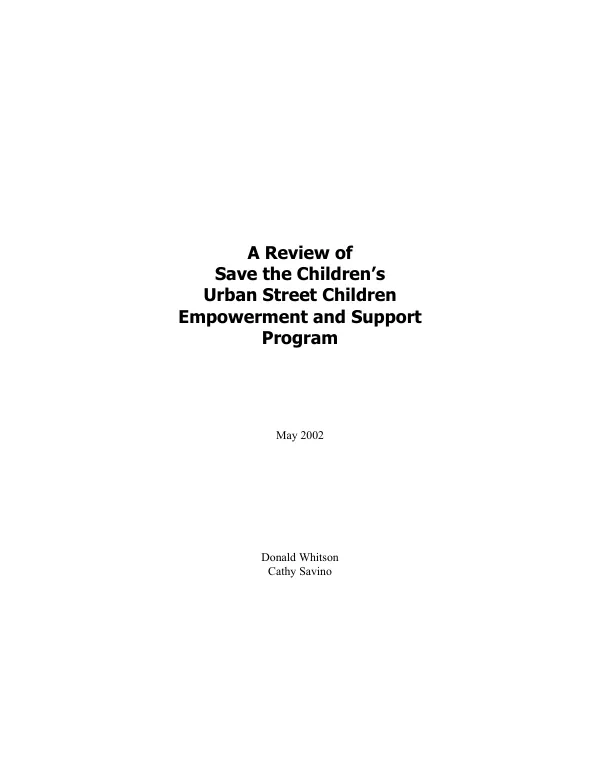
Review of the Save the Children's urban street children empowerment and support program
Sign inUSAID DEC
Review of the Save the Children's urban street children empowerment and support program
Evaluates program implemented by Save the Children (SC) to improve the health and welfare of children (especially girls) living and working on the streets in Indonesia's urban areas.
Whitson, Donald|Savino, Cathy · 2002
Sign in to readA free account is required to download.
Abstract
The program operates in four cities -- Jakarta, Surabaya, Medan, and Bandung -- through subgrants to 39 NGOs. Interim evaluation covers the period 8/00-5/02. Almost 2 years into a 3-year project, no clear successful strategy has emerged as a means to improve the health and welfare of street children. The slow start and the lack of attention by SC leadership delayed progress. Only the personal determination of the project director and her staff, as well as USAID's ultimately forceful intervention, have created the impetus to move this grant forward. It is unclear whether the children being helped are those most in need. Two different types of children are involved. For older children, few viable alternatives for living on the street or for improving the conditions and prospects for children working in the street are evident in SC's program thus far. Living alternatives are largely limited to sleeping at drop-in centers or shipping children off to orphanages maintained by religious groups. Vocational training programs are small, poorly developed, and lack connections with real employment opportunities. The business sector is almost completely absent from the picture. This difficulty is especially true with regard to programs for older girls. Younger children (under 14) pose a different problem. In Indonesia, the trend toward a higher percentage of younger street children and younger girls being pushed by their families to work on the street for economic reasons is not addressed by the intermediate results section of the proposal. Those children make up more than 75% of the children being served by SC's partners. The majority of those younger children live at home and depend on their parents for food. Still, they are vulnerable and are being exploited. Solutions that aim to "fix the child" through counseling, vocational training, and "alternative living arrangements" are not appropriate for this growing group of younger children. Creative community-based solutions are needed to prevent the younger children from being exploited by their families and communities. The large number of small NGOs requires inordinate amounts of TA for institutional strengthening, while the long-term prospects for their survival as NGOs are weak. There are some positive experiences on which to build, but the next steps, involving analysis of what works and what does not, as well as strong criteria for those choices, will be critical in the next phase. Community mobilization is repeatedly cited as a central strategy, but it was omitted from the project design. Although SC encouraged prospective recipients to include community mobilization strategies in their proposals, few did so. Highlights of SC's strengths include the following: (1) The current staff members clearly are well qualified and well respected, and the staff seems well equipped to move into the next phase of development. (2) Using SC's experience in positive deviance may be a promising methodology in the area of prevention and community mobilization in support of children. (3) Staff members have a good understanding of the population they serve and seem well aware of the challenges they face in reaching that segment of the population.
Related documents
![DCOF [Displaced Children and Orphans Fund] Indonesia : a report on Save the Children's urban street children program](https://covers.devme.ai/gen/4958.webp)