USAID DEC
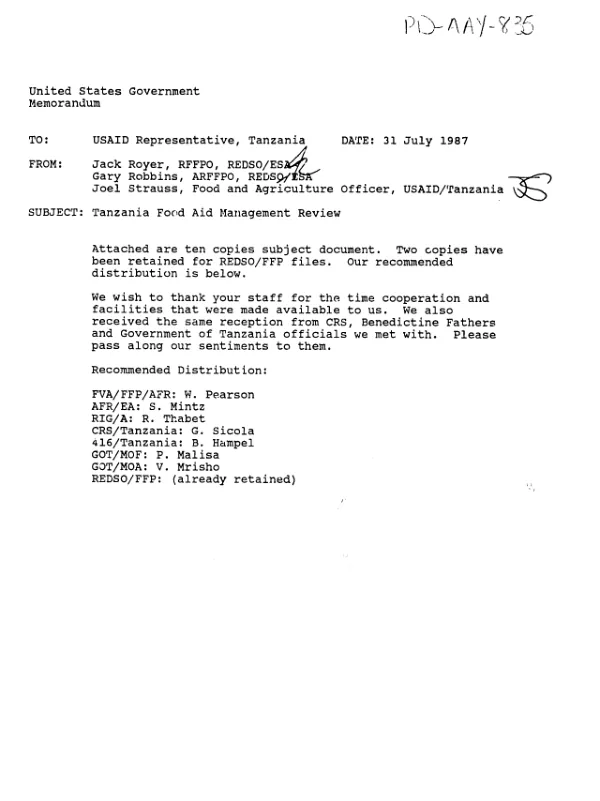
Review of the Tanzania food aid program : Dar es Salaam -- March 22-31 and July 19-25, 1987
Sign inUSAID. BUR. FOR FOOD FOR PEACE AND VOLUNTARY ASSISTANCE. OFC. OF PROGRAM POLICY AND MANAGEMENT
Review of the Tanzania food aid program : Dar es Salaam -- March 22-31 and July 19-25, 1987
Evaluates the Food for Peace (FFP) program in Tanzania, specifically: (1) the regular Catholic Relief Services (CRS) program which has operated since 1962; (2) the Section 416 program which began in 1984, receives food under the aegis of the Salvatorian Mission Warehouse (SMW), and is administered by the Benedictine Fathers and officials of 5 dioceses in southern Tanzania; and (3) two programs (FY84/85) under which Title II vegetable oil was sold to generate counterpart funds to support emergency feeding.
Royer, Jack; Robbins, Gary +1 more · 1987
Sign in to readA free account is required to download.
Abstract
The evaluation does not deal with the emergency program itself, nor with the Section 206 program which began in 1987. The CRS program has undergone two cutbacks since 1981. The most recent, which was completed during this evaluation, reduced the program to 24 maternal/child health (MCH) centers in 3 regions. These cutbacks represent an attempt by CRS to improve management. A new food management team has been organized to improve the supply of food to the centers, along with a documentation system to track FFP commodities. In addition, CRS has been refocusing the program. It has initiated village-based MCH programs, which concentrate on smaller geographical areas than do the traditional programs, which are operated at clinics or hospitals. Also, recipient contributions are used for associated development activities (ADA) in the village. ADA"s are meant to increase the income/food production of Title II recipients and of the village in general. While the CRS program looks very good on paper, the reality is somewhat different. Commodities have not been in constant supply at the centers, few ADA"s have been implemented and their effectiveness is still problematic. Personnel at the centers are poorly trained. The reviewers believe that it is too soon after CRS"s reorganization to make a final judgment on the new system. It will take time for CRS employees to learn their new roles and to work out the bugs. As for the Section 416 program - a charitable effort to deiiver food to people considered to be in need - there are no stated goals or objectives beyond the delivery of food, no targeting of recipients based on nutritional criteria, and no plans to phase over or out of the program. In short, the program could not qualify for Title II food. The management of Section 416 commodities is excellent, and many needy people are benefiting. Several recommendations are made in this evaluation. If these steps are taken, the program would still fall short of Title II guidelines in many ways, but the effectiveness of the MCH and kindergarten components could be improved and both the program"s sponsor and A.I.D. could gain a better understanding of the program"s value. Finally, although the 2 monetization programs were very difficult to negotiate, and encountered major problems, they did provide a large amount of local currency on a comparatively small investment of U.S. funds. Recommendations are presented. (Author abstract, modified)