USAID DEC
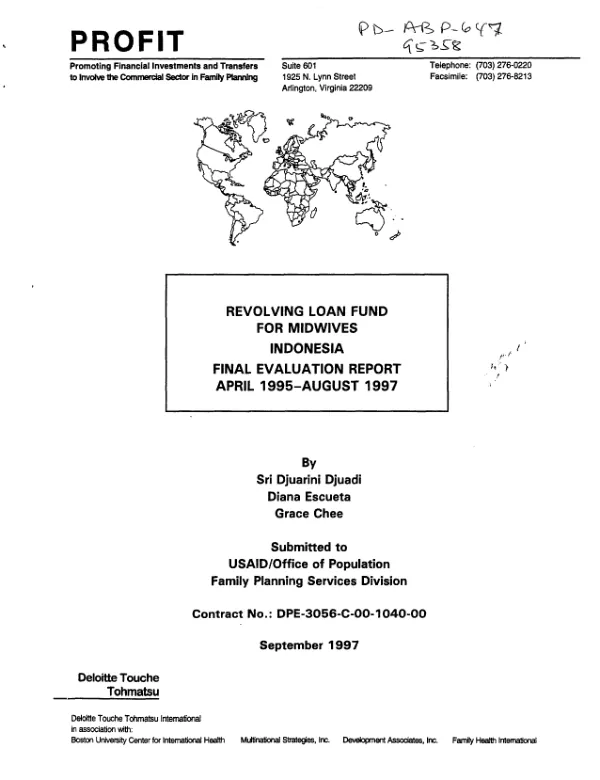
Revolving loan fund for midwives : Indonesia -- final evaluation report, April 1995-August 1997
Sign inDELOITTE TOUCHE TOHMATSU INTERNATIONAL
Revolving loan fund for midwives : Indonesia -- final evaluation report, April 1995-August 1997
Final evaluation of a subproject (4/95-8/97) of the Promoting Financial Investments and Transfers (PROFIT) Project to establish a $1 million Revolving Loan Fund to help Indonesian midwives expand their private practices.
Djuadi, Sir Djuarini|Escueta, Diana|Chee, Grace · 1997
Sign in to readA free account is required to download.
Abstract
The program worked closely with the Indonesian Midwives Association (IBI), Bank Rakyat Indonesia (BRI), the country's largest micro-lending institution, and the National Family Planning Coordination Board (BKKBN) in 50 districts in West, Central, and East Java, and in Jakarta and Bali. The subproject achieved its objectives: the Loan Fund has provided 538 loans to borrowers who have used the money to expand or establish private practices. The high repayment rate (just one borrower has defaulted) allows the funds to be re-lent to other midwives. Lending will be sustained after PROFIT departure in 9/97: due to continued strong demand for loans and a high level of enthusiasm from the partners, PROFIT and USAID granted its initial capital contribution to a local foundation, Yayasan Bhakti Kencana (YBK), which, along with BKKBN, and IBI, will jointly manage the fund. BRI will continue to capitalize half of the loans. It is still too early to determine the longer-term outcomes of the Loan Fund, but the borrowers are contributing to an increase in new contraceptive acceptors and a shift of clients from the public to the private sector. The program's most unique achievement was its ability to establish a sustainable collaboration among three very different partners. Several lessons can be drawn from Fund's experience. (1) A realistic timeframe and appropriate tools are required to measure results. (2) It is important to have committed partners with a full range of skills and interests. (3) A realistic assessment of each partner's capabilities, objectives, and overall organizational structure allows potential weaknesses to be addressed through appropriate subproject design. (4) Support from a committed and influential partner can be a critical ingredient for success. (5) A financial institution with experience in small-scale lending and extensive market coverage eases the process of loan processing and disbursement. (6) Endorsement from a well-established and -regarded professional association lends credibility to the subproject. (7) Communicating consistent information to all levels of partner organizations can prevent implementation problems.