INTERNATIONAL RICE RESEARCH INSTITUTE (IRRI)
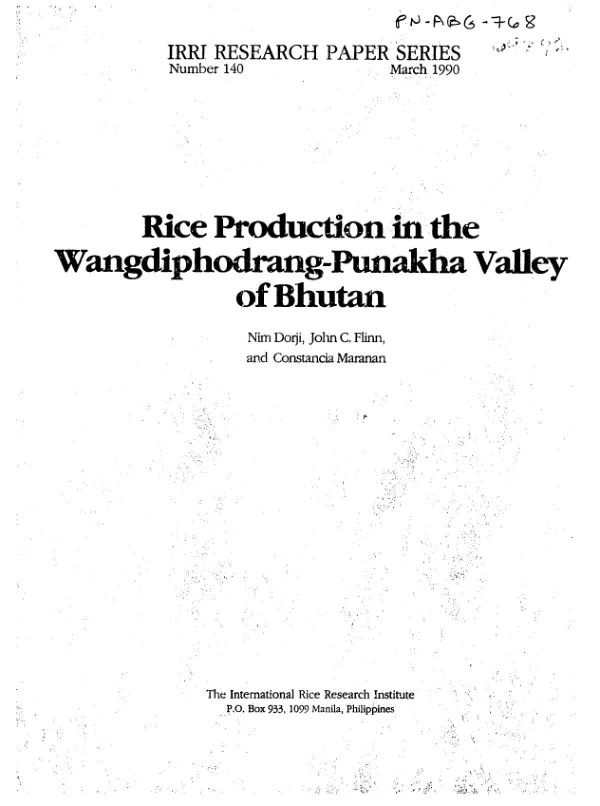
Rice production in the Wangdiphodrang-Punakha Valley of Bhutan
A farm survey was conducted in the Wangdiphodrang-Punakha Valley of Bhutan, Philippines, to document methods of rice production, provide a basis for measuring the impact of the national rice program, and identify research priorities.
Dorji, Nim; Flinn, John C. +1 more · 1990
Sign in to readA free account is required to download.
Abstract
The dominant crops in the valley were rice in summer, and wheat, mustard, and buckwheat in winter. Local rice is broadly classified as maap (red rice) or kaap (white rice). Kaap accounted for 61% of the rice area at low elevations (less than 1,500 m); maap, 36%; and modern rice (MPR and IR36), 3%. Maap accounted for 92% of the rice area at high elevations, while kaap covered the remaining 8%. At low elevations, the average yield of maap rice (1.5 t/acre [3.7 t/ha]) was slightly higher than that of kaap (1.4 t/acre [3.5 t/ha]), but the difference was not significant. Both kaap and maap rices yielded 1.3 t/acre (3.2 t/ha) at high elevations. The most important determinant of rice yield was land quality. On the best quality land, average rice yields were 1.5 t/acre (3.7 t/ha); on medium-quality land, 1.3 t/acre (3.2 tlha); and on poor land, 1.0 t/acre (2.5 t/ha). Rice production was labor intensive, as some 112 days/acre (280 d/ha) was used to grow the crop. More than 40% of the labor was used for harvesting, threshing, and associated operations. Few purchased inputs were used. The major inputs were farm household produced owned seed, bullock power, human labor (mainly women), and compost. The value of farm-produced and -used inputs (e.g., straw and compost) influenced net returns to rice production. Net returns to owned land were 325 Nulha (US$=12.8 Nu) when the value of farm- produced inputs was ignored, and 525 Nulha when these inputs were valued at their shadow market prices. Technology that would reduce labor constraints (e.g., mechanical threshers, improved weed control, direct seeding) appears to be attractive to rice farmers, and its development should receive research attention. Agronomic research to ensure the long-term stability of more intensive rice-based systems (fertility management, identification and assessment of insect and disease damage, development of response strategies) should continue to be encouraged. Increased rice production could lead to increased marketing surpluses, implying that rice prices and market development may become a more pressing issue for the government. (Author abstract)
Related documents