USAID DEC
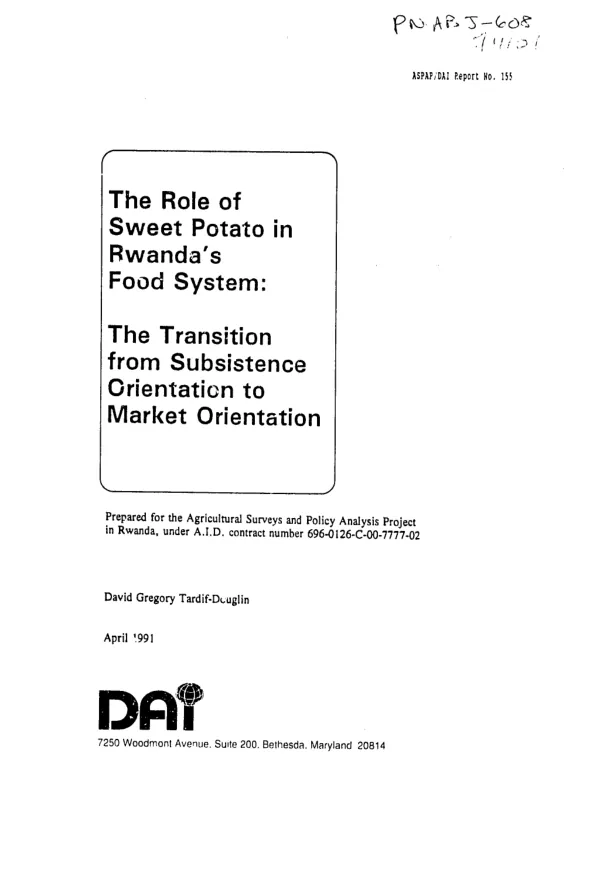
Role of sweet potato in Rwanda"s food system : the transition from subsistence orientation to market orientation
Sign inDEVELOPMENT ALTERNATIVES, INC. (DAI)
Role of sweet potato in Rwanda"s food system : the transition from subsistence orientation to market orientation
The sweet potato is a highly important source of calories in the cool humid climates of the highlands of the Western Branch of Rwanda"s Great Rift Valley.
Tardif-Douglin, David G. · 1991
Sign in to readA free account is required to download.
Abstract
Since its introduction in the early 18th century, the sweet potato has come to be cultivated by nearly all farm households in this rugged region of dense population and high elevation. The popularity of sweet potato in the countryside, among semi- subsistence farmers, does not seem to extend to the rapidly expanding urban population. Urban households consume about half the amount of sweet potatoes as rural households. The principal reason for this difference is related to marketing problems. The sweet potato market has not developed the linkages and economies necessary for it to provide sweet potatoes to distant urban markets inexpensively and reliably. To provide information about this little-studied market, a series of surveys of producers, merchants, transporters, and consumers was conducted during 14 months of field work. Prices were also regularly recorded. The results permit a detailed description of the market -- of its strengths, weaknesses, and potential for improvement. Two types of regression analysis applied to primary and secondary price data show that the sweet potato market is poorly integrated and that its development has been retarded relative to the cassava market. To determine the source of market inefficiency, a profit equation was fitted to data from 29 merchants. It was found that smaller-scale merchants, of whom there are many, are relatively less economically efficient than their larger-scale counterparts. If sweet potatoes are to play a more important role in urban diets, the market must address the bulkiness and perishability characteristics of the sweet potato. Until they are addressed, certain measures can be encouraged; among the most important are expanding size of operations, changing the system of taxation, and improving product handling. (Author abstract)
Related documents
Documents in this collection
 1992
1992USAID DEC
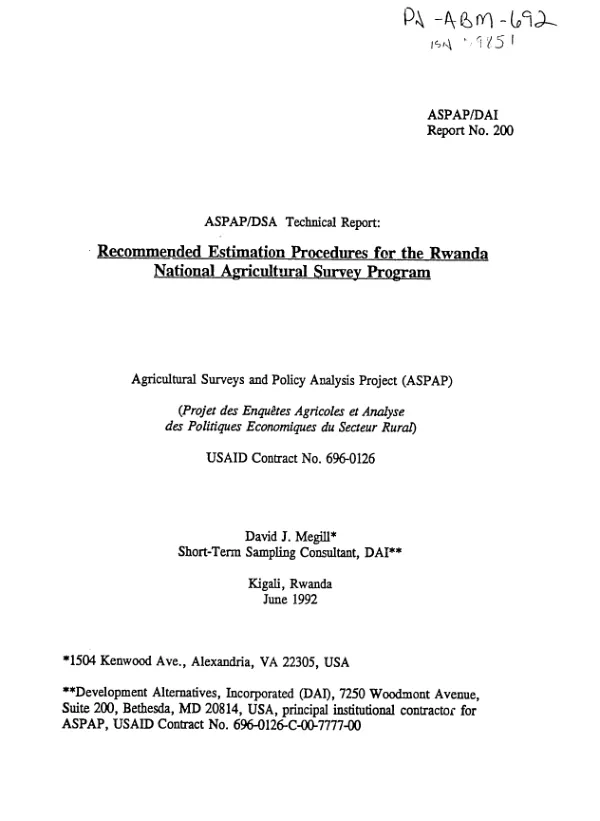
Recommended estimation procedures for the Rwanda national agricultural survey program
Open record 2007
2007USAID DEC