USAID DEC
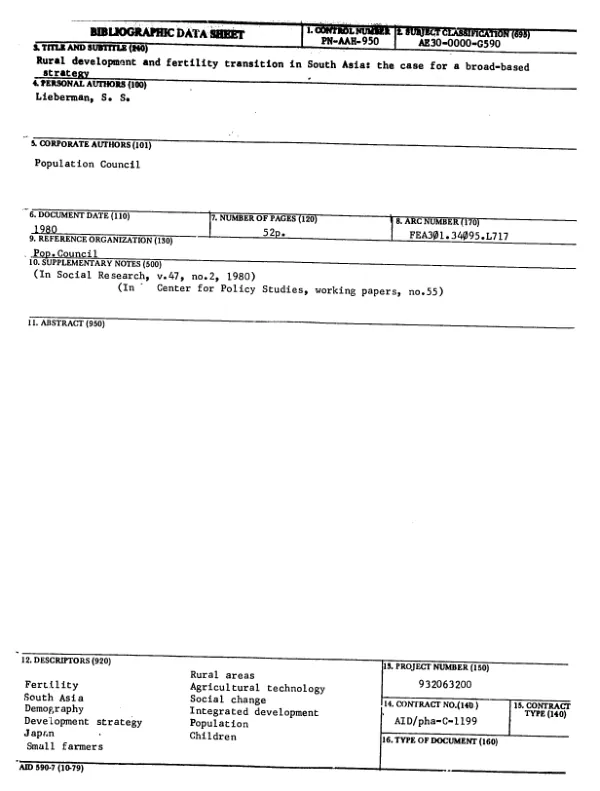
Rural development and fertility transition in South Asia : the case for a broad-based strategy
Sign inPOPULATION COUNCIL
Rural development and fertility transition in South Asia : the case for a broad-based strategy
A point of contention for many population planning and development experts is the relationship, if any, between rural development programs and fertility -- how can the two be integrated to simultaneously achieve gains in employment and output while reducing fertility?
Lieberman, Samuel S. · 1970
Sign in to readA free account is required to download.
Abstract
This paper addresses this issue by examining a broad-based strategy of agricultural development inspired by the Japanese experience and by discussing the applicability of that strategy to South Asia in general. Presented first are the major aspects of the broad-based strategy which integrates rural development and fertility reduction through a small farmer approach -- the so-called "green revolution." The success of this approach in Japan is documented and a number of advantages to the small farmer strategy are listed. Of particular interest is the traditional view that fertility reduction is exclusively and specifically a function of the improved standard of living for small farmers which results from development actions. The author contradicts this view by providing evidence that fertility decline in Japan was caused, not by improved living conditions, but by changes in the productive contribution of children and in their perceived value as investments or security assets. He argues that it is only by introducing organized forms of security and support to replace the old age and disaster insurance roles of children that fertility will decline. He also discusses the limited applicability of the Japanese model in the South Asia situation because of differences in the political, economic, and agricultural structures between the two regions. Finally, two alternative broad-based strategies are presented; their major departure from the Japanese model is that a much more extensive scope of government involvement in development policy is envisioned. The two strategies, integrated rural development and guaranteed employment, are explained and their possibilities for the South Asia context are discussed. The report concludes with supporting footnotes and a 156-item reference list (1951-79).