USAID DEC
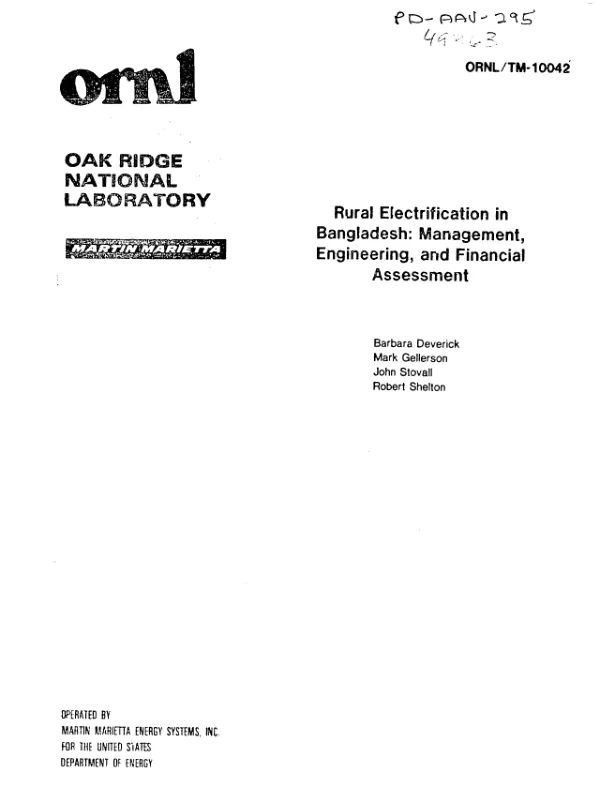
Rural electrification in Bangladesh : management, engineering, and financial assessment
Sign inMARTIN MARIETTA ENERGY SYSTEMS, INC.
Rural electrification in Bangladesh : management, engineering, and financial assessment
Evaluates rural electrification (RE) project in Bangladesh.
Deverick, Barbara|Gellerson, Mark · 1986
Sign in to readA free account is required to download.
Abstract
External evaluation covers the period through 7/86, is based on site visits, and analyzes four project areas: the RE management system; systems planning and engineering; RE tariffs and energy sector pricing policies; and TA. The RE management system has been extremely effective and the major administrative units have successfully carried out their basic objectives and major functions. The Bangladesh RE Board (REB) has developed the distribution cooperatives (called Palli Bidut Samities - PBS's) to the point where the local personnel can carry out their primary duties. More importantly, the REB has the engineering capabilities to carry out RE in Bangladesh. The competency of the engineering staff is quite high and the experience being gained by the system planning and engineering staff should greatly add to the decisionmaking capabilities of the REB and PBS's over time. The underlying economic soundness of the PBS's is improving as they mature. Financial performance is generally strongest in those PBS's which supply relatively large amounts of power to irrigation and industrial customers. However, it is likely that most PBS's will not be fully able to meet the current schedule of loan repayment and it appears unreasonable to require all PBS's to begin full repayment only 5 years after their organization. Repayment requirements should be tailored more specifically to the economic potential of the various PBS's. TA has been successful in building the REB and the PBS's into viable institutions. As 12-15 years of TA are needed for an RE program, one can expect a continuing need for TA in Bangladesh, which began its program in 1978. However, less TA is needed as each new phase is implemented. A total of 20 advisors are recommended for the A.I.D. follow-on project, RE III, scheduled to begin in FY87. Several specific recommendations for Phase III operations are included. (Author abstract, modified)
![Mid-term evaluation of the NRECA [National Rural Electric Cooperative Association] Central America rural electrification support program (CARES)](https://covers.devme.ai/gen/6781.webp)