USAID DEC
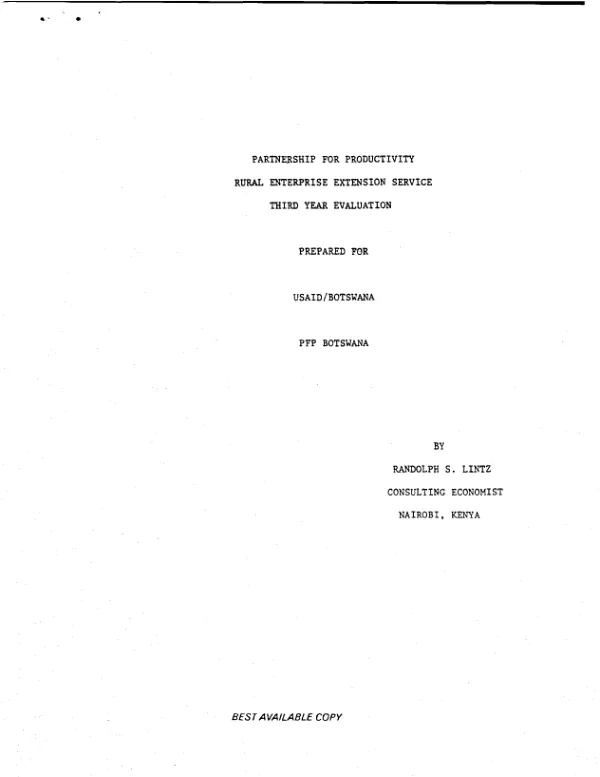
Rural enterprise extension service; third year evaluation; Partnership for Productivity
Sign inUSAID. MISSION TO BOTSWANA
Rural enterprise extension service; third year evaluation; Partnership for Productivity
Evaluates project to establish an extension program for rural small businesses (SB) in Botswana.
Lintz, Randolph S. · 1981
Sign in to readA free account is required to download.
Abstract
Evaluation covers the period l0/80-9/8l and is based on a review of project files, discussions with USAID/B and Partnership for Productivity (PFP) contractor staff, and interviews with trainees and Government of Botswana (GOB) and private individuals. A high-quality SB skills extension service using local staff with an efficient reporting and monitoring system is in place, and PFP has developed an excellent SB skills curriculum package. Training has been provided to 26 local advisors to the PFP and Ministry of Industry and Commerce (MCI) Business Advisory Service (BAS) programs and to 288 (181 in FY81 alone) of 975 targeted clients, who have included school-leavers. However, 63 FY81 trainees were dropped for lack of interest, business closure, and the like, thus showing the invalidity of two project assumptions -- that businessmen in Botswana are ambitious and that an indigenous environment favorable to SB's exists. Trainees have testified that the training has benfitted enterprise management. MCI and PFP must resolve the differences in their systems, i.e., the PFP program is relatively input-intensive in regard to training, supervision, and reporting while MCI's is not, prior to 4/82 merger of their BAS programs. MCI should relieve its current BAS Program Senior of all duties other than direction and planning of an SB skills expension service, if necessary providing an interim program director and training a MCI-designated counterpart. The field supervisor, the key link between MCI headquarters and field operations, should be experienced in BAS operations. Staff duties and program objectives should be clearly defined and pertain only to the extension service; a project memorandum should assure access to funds needed to support the BAS staff after the merger; a training unit within the MCI, catering to educational needs of all MCI departments, could use the standard PFP curriculum to support ongoing BAS staff development. The project has taught that a localized extension service, despite its high cost, is one of the few effective ways to encourage SB development in Botswana; and, above all, that the project's long-term success depends on effective functioning of the GOB.