OHIO STATE UNIVERSITY. DEPT. OF AGRICULTURAL ECONOMICS AND RURAL SOCIOLOGY
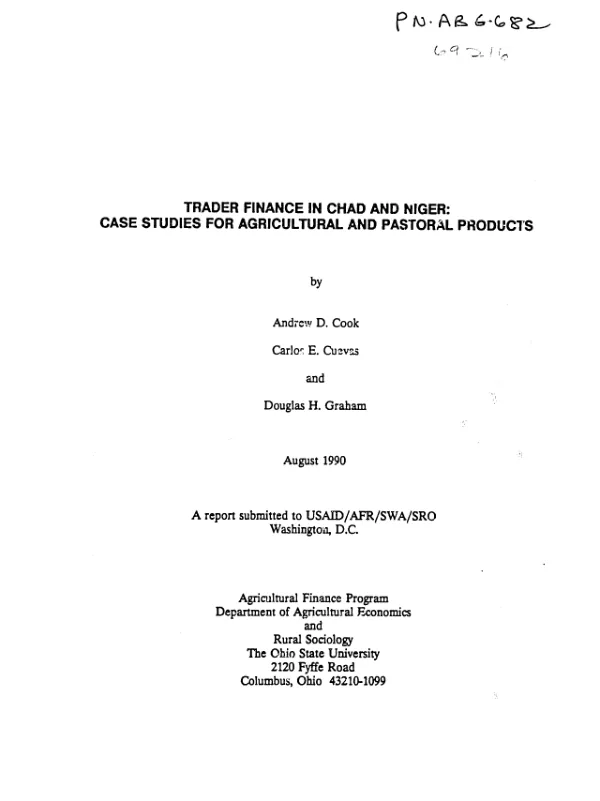
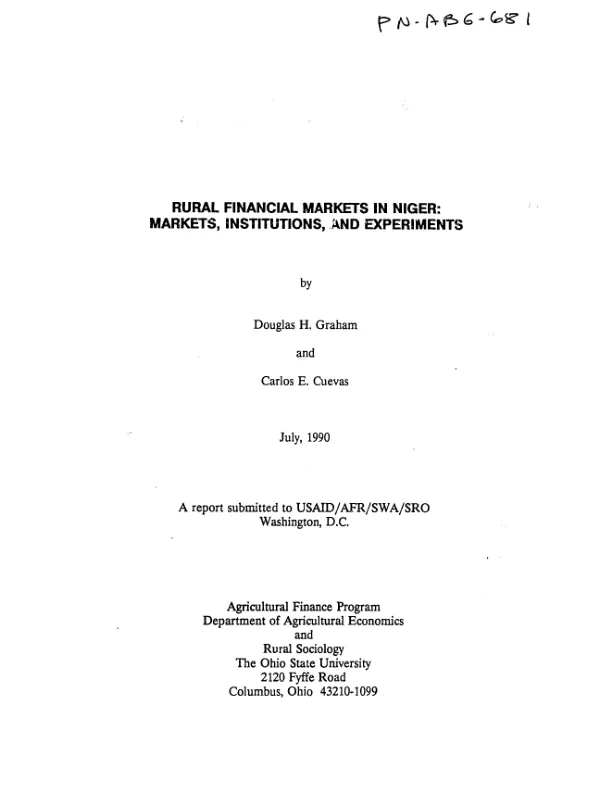
Rural financial markets in Niger : markets, institutions and experiments
The rural financial markets (RFM"s) of Niger reflected several contrasting strategies of institutional change and collapse during the 1980"s.
Graham, Douglas H.; Cuevas, Carlos E. · 1990
Sign in to readA free account is required to download.
Abstract
First was the struggle and final demise of the supply leading financial development strategy promoted through the Caisse Nationale de Credit Agricole. Next came the institutional innovations associated with two distinct PVO driven models designed to supply a marginal rural clientele with financial services from a grassroots base of village cooperatives. This report reviews the key features of this experience with financial innovations in the RFM"s of Niger. The next section summarizes the key findings of the comprehensive field research of formal and informal rural financial markets carried out by the Ohio State University in the mid-1980"s. This is followed by a section setting forth the most recent RFM project initiative launched in Niger, the World Council of Credit Unions" project establishing the first credit unions in the country, as a result of the recommendations derived from the OSU study. The fourth section reviews a longer standing PVO initiative to rejuvenate village-based cooperatives, i.e., the BIAO-CLUSA project begun in 1985. Finally, the report highlights the similarities and differences between these two distinct PVO models that are currently changing the institutional landscape of village-based cooperatives in rural Niger. The lessons learned from these two experiments in rural financial institutional innovations will no doubt influence research and policy action in other African countries in the future. (Author abstract)