INTERNATIONAL FOOD POLICY RESEARCH INSTITUTE (IFPRI)
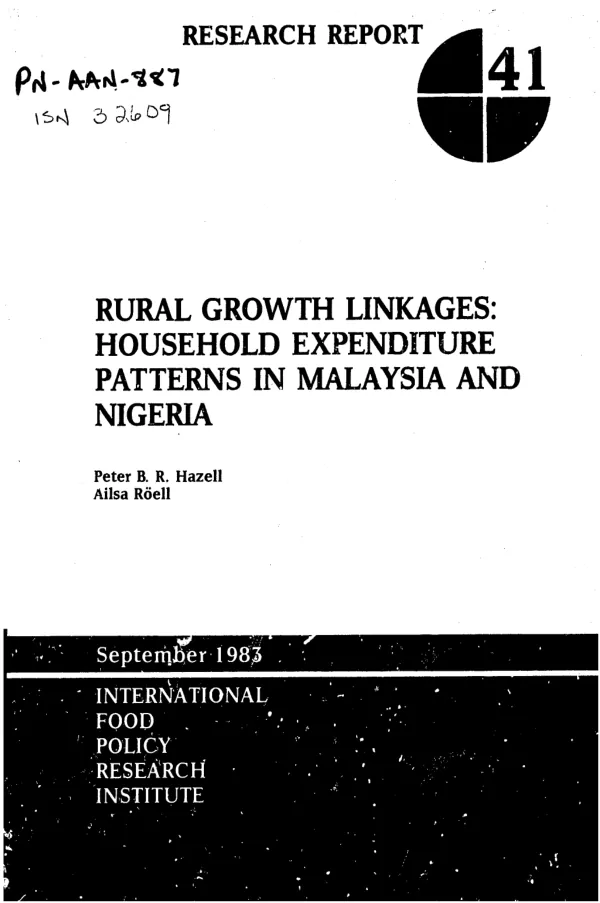
Rural growth linkages : household expenditure patterns in Malaysia and Nigeria
Linkages between agricultural growth and the rural nonfarm economy are the subject of this study of household expenditure patterns in areas benefiting from two World Bank projects.
Hazell, Peter B.; Roell, Ailsa · 1983
Sign in to readA free account is required to download.
Abstract
Introductory sections treat the indirect economic effects of agricultural growth; the geography, social structure, landholding patterns, and living standards of the two study areas, the Muda irrigation project in northwest Malaysia and the Gusau agricultural development project in Nigeria; and data sources and methods of data analysis. Household expenditure behavior is then broken down by commodity group, per capita income, and farm size, and linkages between expenditures and the origin of the goods bought are outlined. Results show that larger and richer farm households spend more on local nontradable goods and services than do smaller and poorer ones and are thus more likely to stimulate local economic growth, making them more suitable targets for agricultural interventions. The authors qualify this conclusion in several ways, however (e.g., large farms in the study areas may not be large by other standards, large farm savings may not stay in the local economy), and suggest that study findings may indicate the need for a trade-off between growth and equity.
Connected topics