USAID. MISSION TO TUNISIA
Rural potable water institutions
Summarizes mid-term evaluation (XD-AAZ-603-A) of a project to improve Tunisia"s water system by: (1) developing a decentralized model for rural water operations and maintenance involving user participation and fees; (2) improving site selection for water systems; and (3) increasing access to potable water for underserved rural populations.
1989
Sign in to readA free account is required to download.
Abstract
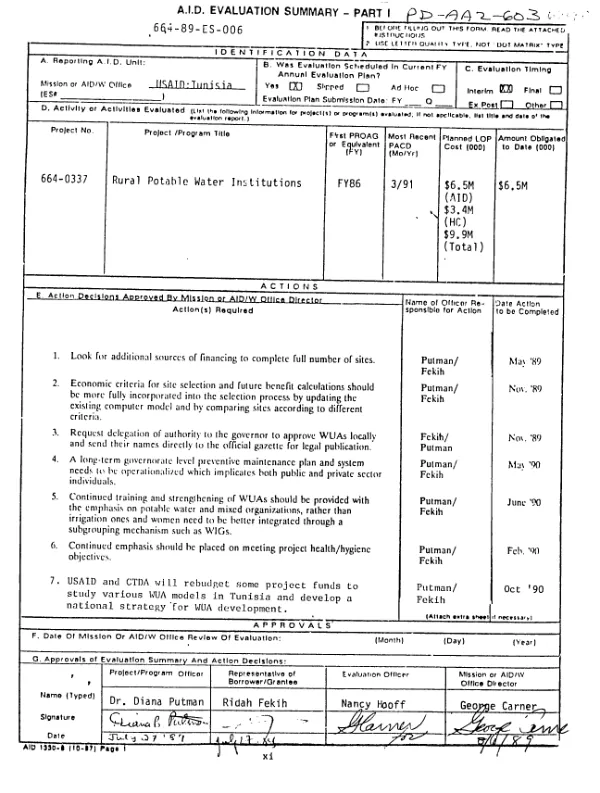
The evaluation covers the period FY86-2/89. Substantial progress has been made. A total of 120 water user associations (WUA"s) have been established at potable water points; of the 120 pump operators, 87 have been partially trained, and all the WUA presidents have received an initial orientation to their roles and responsibilities. The project has trained 17 community health workers and another 20 are currently being selected for training. In 2/89, the President of Tunisia made the establishment of WUA"s for rural potable water systems a high priority. Although this decision may not have been directly related to the project, it gives the project the highest possible level of political support. Ten new potable water sites have been selected with community involvement and using new site selection criteria, a hydrogeologic data base, and a water resources mapping study. Using the same procedure, sites for 7 new boreholes, 2 extensions, and a house connection system have been selected and will soon be proposed to USAID/T. These plans could maximize potable water investments in the project area and could be adopted for all sites if current efforts to improve collaboration and coordination of all involved parties are continued. Access to potable water has been improved through completion of 14 productive boreholes and 3 civil works constructions. However, due to the higher than anticipated costs of these activities, the remaining project funds will not be sufficient to achieve the goal of at least 30 new installations (26 boreholes, 4 extensions, and up to 2 pilot house connections). An action decision is to seek additional sources of financing to complete the full number of sites. Lessons learned are as follows: (1) USAID/T should strengthen its support for women in development activities in sectors where women traditionally play an important role; (2) in regional projects in Tunisia, more attention, should be given to activities in other regions and those activities and plans of other donors; (3) USAID/T"s long-time strategy of emphasizing aid to the Central Tunisian Development Agency is succeeding in strengthening management within that agency.