USAID. MISSION TO MAURITANIA
Rural roads improvement Mauritania
Summarizes attached evaluation of the road maintenance component of a project to improve the rural road network in the Guidimaka and Gorgol regions of Mauritania.
Douglass, Raymond; Sid Ahmed, Cheik · 1988
Sign in to readA free account is required to download.
Abstract
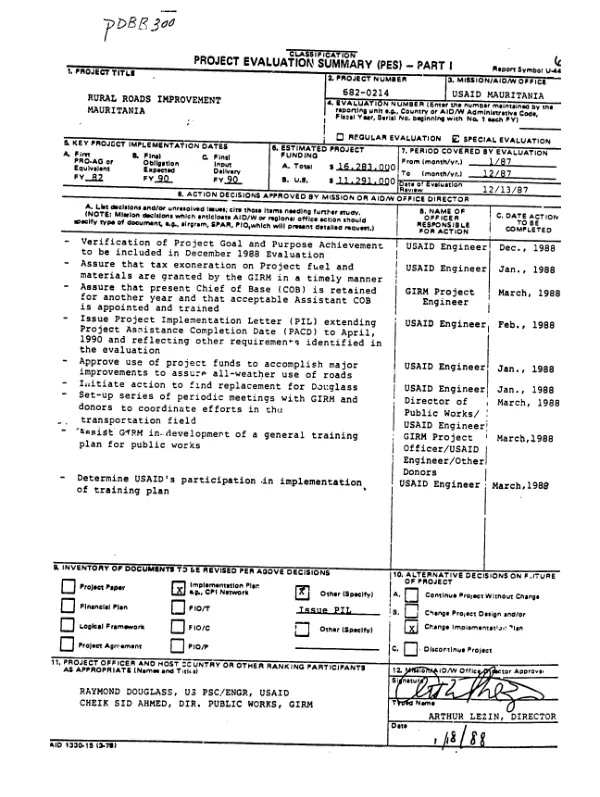
Special internal evaluation covers the first year of the maintenance program (1/87-12/87). Maintenance on the 333 km of road constructed by the project between the regional capitals of Selibaby, Kaedi, and Boghe began in 1/87 under a Fixed Amount Reimbursement agreement between USAID/M and the Government of the Islamic Republic of Mauritania (GIRM). During 1987, the roads have been bladed and/or dragged each month to maintain the surface and to minimize corrugations; additional gabion work was done to repair and reinforce drainage structures damaged during the rainy season; and major drainage structures were reinforced with riprap and the Selibaby bridge foundations strengthened. Thirty-five members of the construction brigade were retained for the maintenance program, and are receiving continuing on-the-job training in secondary gravel road maintenance. Equipment repair and maintenance are carried out by brigade members at the brigade camp in M"Bout, where supplies and spare parts are stored. The quality of the maintenance work has been outstanding and the first year"s work has been completed under budget (USAID/M had projected that first year costs would be $300,000). The project"s main problems are institutional. Although the brigade is performing well with only one expatriate on the staff (and with substantial technical support from the USAID/M Engineering Office), inadequate internal controls and the poor performance of the mid-level staff at the GIRM"s Central Office of Public Works make it nearly certain that that the GIRM will not be in a position to independently assume road maintenance responsibilities in two years as planned. These problems can be overcome, however, with assistance from other donors, most importantly the World Bank, which has pledged to establish an office to manage the use of donor funds for road maintenance. The main lesson this teaches is that road maintenance in Mauritania is not an isolated activity, and that the results can be far reaching, if USAID/M doesn"t isolate itself from other donors and stays with a project. A number of recommendations address these issues; key ones are to retain the current chief of the maintenance brigade and recruit a new assistant chief, and to find a replacement for the USAID/M chief engineer, whose services are scheduled to end soon.
Related documents