USAID DEC
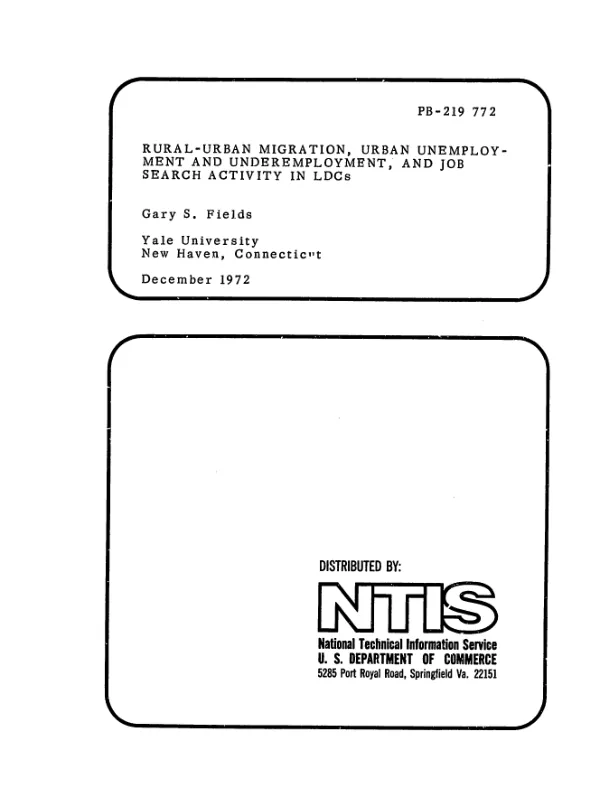
Rural-urban migration, urban unemployment and underemployment, and job search activity in LDCs
Sign inYALE UNIVERSITY
Rural-urban migration, urban unemployment and underemployment, and job search activity in LDCs
A formal theoretical model is presented, with which the equilibrium allocation of the labor force between labor markets is analyzed.
Fields, Gary S. · 1970
Sign in to readA free account is required to download.
Abstract
Following the model of Harris and Todaro, the focus is on the voluntary movement of workers between labor markets as the equilibrating force, instead of the more conventional mechanism of wage adjustment. Four additional factors are considered: a more generalized account of the process of search for urban jobs; favoring of educated workers over uneducated workers by employers in hiring; the possibility of unemployment in the so-called "murky sector"; and recognition of labor turnover in a multiperiod framework. Results are compared with predictions by Harris and Todaro. Urban unemployment rates were found to be considerably lower than predicted by the Harris-Todaro model. The theory of quantity adjustment being the equilibrating mechanism in labor markets is considered. Results presented demonstrate that the resulting framework gives predictions that are closer to actual experience than the Harris-Todaro model.
Connected topics
Related documents