USAID DEC
Rwanda : agricultural survey and policy analysis project (696-0126) -- final evaluation
Sign inCHECCHI AND CO. CONSULTING, INC. (CCCI)
Rwanda : agricultural survey and policy analysis project (696-0126) -- final evaluation
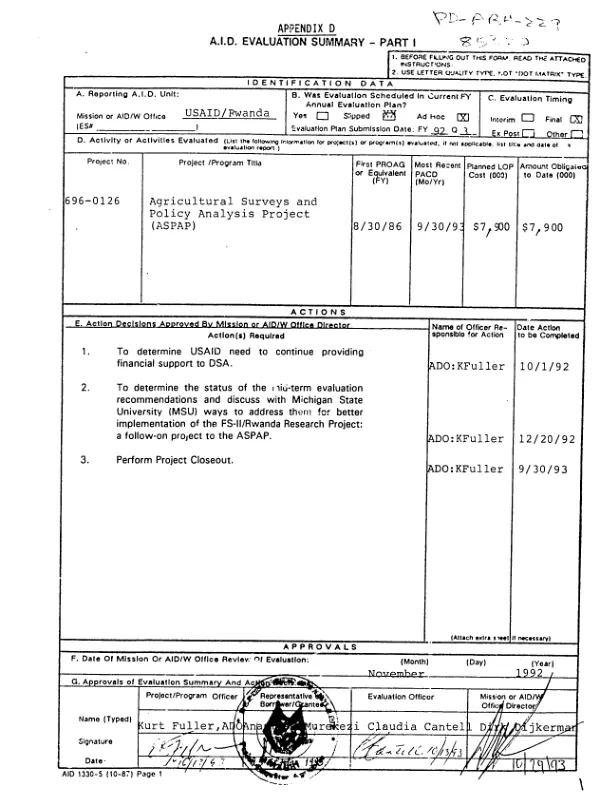
Final evaluation of the Rwanda Agricultural Surveys and Policy Analysis Project (ASPAP) to expand the analytical capabilities of a sample-based, agricultural data collection and analysis system developed under the Agricultural Survey and Analysis Project (ASAP); and to establish linkages between the system and agricultural policy and programming.
Brown, Donald G.; Satana, Suha · 1992
Sign in to readA free account is required to download.
Abstract
The evaluation covers the period 9/86-10/92. The project is a successful one. ASPAP has been able to develop in the Division des Statistiques Agricoles (DSA), a data collection and analysis organization, which, by African standards, is excellent. The project did, however, have some implementation difficulties. Programs at Ministry of Planning (MINIPLAN) and the former Ministry of Finance and Economy (MINIFINECO) (the two other participating agencies in the project) were not successful. The project was also plagued by difficulties with local cost funds and, to a more limited extent, with commodity procurement. Implementation in the last year of the project was also hampered by internal disruption within the country. Despite these difficulties, project objectives were substantially met. The project purpose was to develop an institutional capacity to collect and analyze data on the rural economy, which in turn would help to improve policy and program formulation in the country. The data collection capability built by the project is well recognized, although there are still areas in need of refinement. The evaluation also found substantial evidence of positive impact of the project-generated data on a host of policy and program issues that support the rural economy. While impressive, the evaluation contends that more could be done in linking ASPAP"s data to policy making. Three general lessons were learned from the project: (1) adequate staff is necessary for proper management of USAID"s project portfolio; (2) policy oriented projects must be considered within the political context; and (3) institution building requires long and patient support with particular attention to operational details. Cases may arise where it is in the donor"s best interest to sustain an institution that a host government may not yet be able to afford. (Author abstract)