PRAGMA CORP.
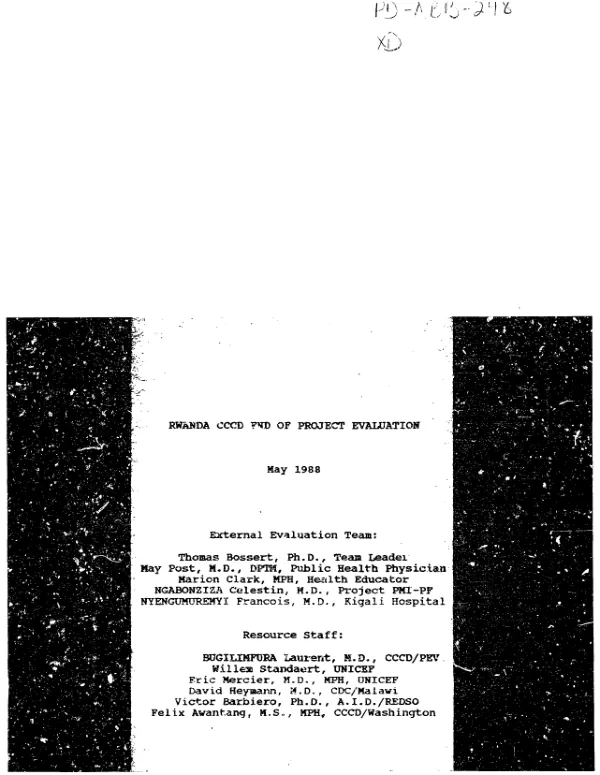
Rwanda CCCD end of project evaluation
Final evaluation of a project to support Rwanda's Ministry of Health and Social Affairs (MOHSA) in a major expanded program of immunization (EPI) initiative and in broadening child survival efforts to cover malaria and oral rehydration therapy (ORT).
Bossert, Thomas|Post, May · 1988
Sign in to readA free account is required to download.
Abstract
External evaluation covers the period 12/84-5/88. The project achieved many significant institutional objectives. MOHSA established well-designed national plans and coordination systems for EPI, ORT, and malaria. Also developed were an innovative check-list approach to supervision and a management information system to monitor coverage and supervision and to provide feedback to regional and local levels. A national health information system is now in a pilot phase. Project interventions were integrated into several national divisions, and the previously vertical EPI program was expanded to the regional and local levels. fragmentation and insufficient institutionalized coordinating mechanisms still present obstacles. Health education efforts were impressive. Repeated short-term TA was provided to develop MOHSA's capacity to implement formative studies, develop and distribute appropriate health education materials, and conduct an effective mini-campaign for EPI. Health talks and home visitations are in evidence throughout the country, and a pilot program is distributing ORT messages which are likely to have significant effect on knowledge and practices. Project-supported studies provided baseline data on knowledge, attitudes, and practices; identified appropriate treatment schedules for the national malaria plan; and guided the development of health education messages. Less positively, project-developed training programs did not reach sufficient numbers of heads of health centers, nor were the sessions long enough for adequate development of skills and knowledge. The project failed to achieve its objectives of supporting operations research projects and developing self- financing approaches. In terms of its impact on health, the project had mixed results. Significant achievements were made in EPI, with impressive levels of coverage in all EPI areas and a dramatic decline in measles, pertussis, polio, and diphtheria. On the other hand, there is no evidence yet of an impact on the incidence of diarrheal diseases, and malaria (for reasons beyond the control of the project) is actually increasing at an alarming rate. The project's malaria activities, which addressed monitoring, studies, and treatment, are insufficient for the magnitude of this problem.
Related documents
![[Development Fund for Africa --] impact of child survival activities in Africa : a report on AID's progress in reducing infant and child mortality and illness in 17 child survival priority countries](https://covers.devme.ai/gen/8905.webp)