USAID. BUR. FOR AFRICA. REGIONAL ECONOMIC DEVELOPMENT SERVICES OFC. (REDSO) WEST AFRICA
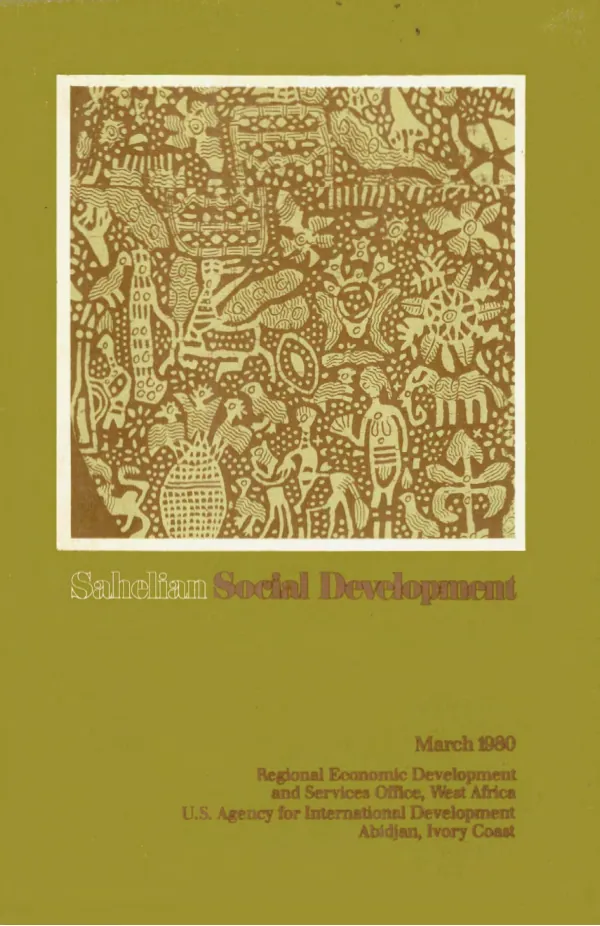
Sahelian social development
Today in the Sahel one can raise animals or plants and be very poor; or one can leave.
Reyna, Stephen P., ed. · 1970
Sign in to readA free account is required to download.
Abstract
Such is the dilemma examined by the five authors whose studies of Sahelian social development comprise this book. "A Brief History of the Sahel" concentrates on the pre-colonial, colonial, and post-colonial eras of development and their effect on the ecosystem and people of the Sahel. "The Fulani in a Development Context" refutes the stereotype of Sahelian pastoralists as a people so infatuated with their animals that they wander about the bush singing songs and dedicating poetry to their beasts, when they should be selling them at the local abattoir. The Fulani (who instead sell milk and butter) see their herds as a trust and are unwilling to part with any of their dividend-producing stock. Furthermore, the Fulani are nomads, not because they love wandering, but because it enables them to feed their cattle. Thus, what is often perceived as backwardness is in reality a rational adaptation to a limited, harsh environment. "The Conditions of Agricultural Intensification in the West African Savannah" examines climate, soils, and farming practices in the Sahel region. Following a general discussion, three case studies are outlined involving the Kasasi of Ghana, the Hausa of Nigeria, and ethnic peoples of the Niger Delta of Mali. Although the authors fail to see any simple relationship between environment and farming systems, they note that existing food-production strategies do seem designed to minimize environmental risks. In "Development for Whom", the author addresses the distribution of benefits from large-scale agricultural intensification projects (especially irrigation projects) and concludes that the rural poor are not among the beneficiaries. In most instances, these projects are actually resettlement schemes, forced on and inhospitable to local culture and traditions. In "Cooperatives, Initiative, Participation and Socio-Economic Change", the author reaches similar conclusions with regard to the impact of government-run cooperatives and parastatals. Footnotes or bibliographies follow each article. Most of the publications listed are in English, with a significant number of French titles appearing as well.
Related documents