USAID DEC
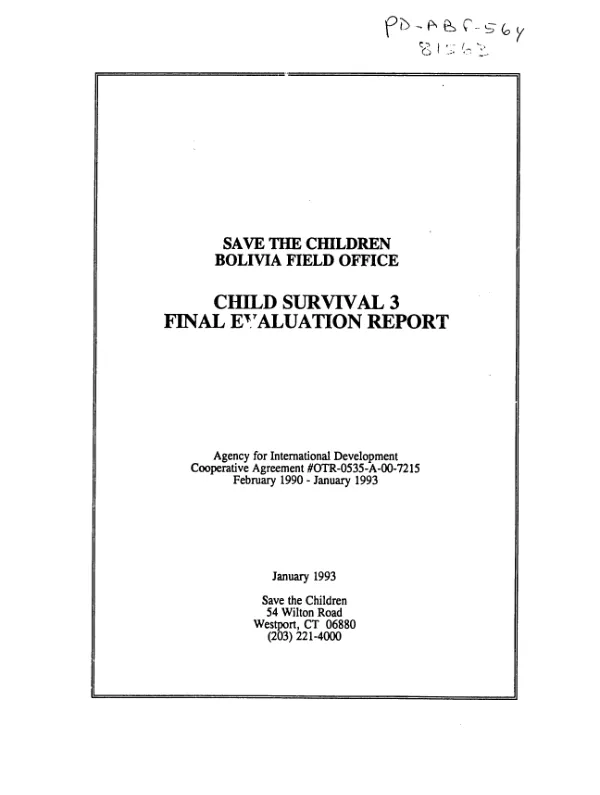
Save the Children Bolivia field office : Child survival 5 -- final evaluation report
Sign inSAVE THE CHILDREN (U.S.)
Save the Children Bolivia field office : Child survival 5 -- final evaluation report
Final evaluation, conducted by the grantee, Save the Children/Bolivia (SC/B), of a child survival project in Inquisivi, Licoma, and Circuatao zones of Bolivia"s La Paz Department.
Casreillo, Marcelo; LeBan, Karen · 1994
Sign in to readA free account is required to download.
Abstract
The evaluation includes both quantitative (KAP survey) and qualitative assessments. According to the quantitative assessment, goals were met or exceeded for polio3 and TT2 immunization, management of diarrheal diseases (use of oral rehydration therapy [ORT], adequate feeding with breast milk and fluids), identification of acute respiratory infections (ARI), knowledge and practice of growth monitoring, colostrum administration within the first hour postpartum, weaning practices, consumption of iodized salt and Vitamin A-rich foods, and deliveries attended by trained staff. Results were low, however, with regard to maternal identification of signs of dehydration and knowledge about when to receive treatment during diarrheal episodes (although practice was adequate) and during ARI episodes; the practice of exclusive and prolonged breastfeeding; distribution of Vitamin A capsules (although there was a high level of Vitamin A-rich vegetable consumption); and prenatal care. The qualitative assessment found that SC/B efficiently coordinated the various institutional activities, and its use of integrated development fairs as a mechanism for community mobilization was a success; however, diversification of this strategy to avoid supersaturating the population must be considered. Likewise, methodological alternatives must be emphasized to make training more active and responsive to the target population"s characteristics. Appraisals by women"s groups and community authorities generally coincide with the KAP survey findings. People are satisfied with achievements of EPI, diarrheal diseases management and, especially, the production of Vitamin A-rich foods in vegetable gardens. Findings regarding growth monitoring and iodized salt consumption were also confirmed. Community authorities emphasized problems with the health promoters or village health workers (VHWs) and suggested that an alternative strategy for community outreach be found. It is clear that VHWs are not sustainable since they are resisted within their own communities. In relation to the health information system, the methodology used for providing feedback to the community has proved extremely useful and has increased motivation within the communities. However, it is clear that VHWs are not motivated to participate in data collection. Also, SC/B is duplicating informational activities carried out by the National Secretariat of Health. In the future, there should be better coordination. The project"s most important counterpart has been the Regional Secretariat of Health through the Tres Cruces District. Earlier obstacles to the establishment of smooth working relationships, due in part to personality factors, have been overcome and relations are now very open and collaborative. In regard to sustainability, the project played an important role in influencing decisions at the policy level. Formal community authorities, such as general secretaries of agrarian unions, became part of the project. SC/B has also been working continuously to institutionalize the project"s key components by strengthening related capacities of the Regional Secretariat of Health. Another notable achievement of SC/B that should contribute to overall project sustainability is the integration of activities with other projects serving local community needs in the areas of education, economic opportunities, and agricultural production. Efforts in health promotion and education based on cultural respect also contributed to sustainability. Incorporating local input into all activities involving change increased the possibility of successful adoption of new behaviors. Finally, SC/B is working to empower communities economically through other systematic actions, thereby improving the economic basis of the communities in order to support desired social change. (Author abstract, modified)