USAID DEC
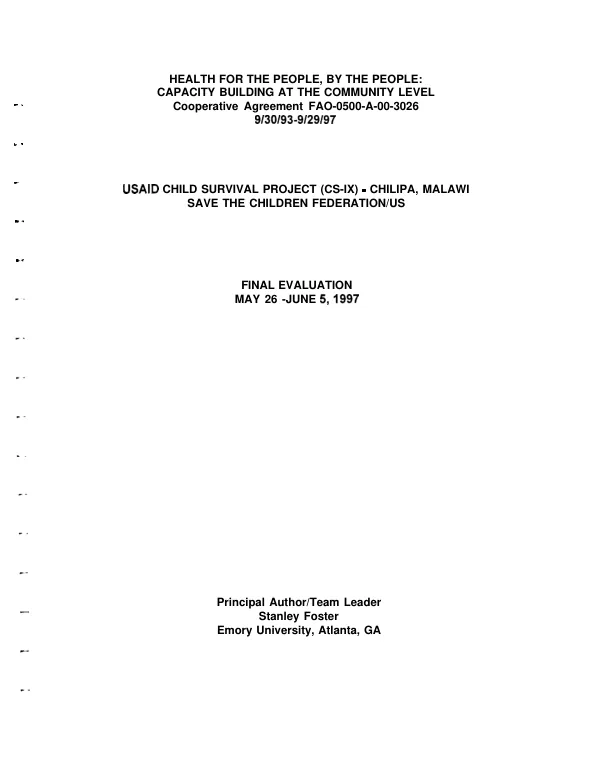
Save the Children Malawi field office : Chilipa (Mangochi) impact area -- child survival 9 : midterm evaluation
Sign inSAVE THE CHILDREN (U.S.)
Save the Children Malawi field office : Chilipa (Mangochi) impact area -- child survival 9 : midterm evaluation
Mid-term evaluation of a project to support child survival activities in the Chillipa area in Mangochi District in Malawi.
Franco, Lynne · 1995
Sign in to readA free account is required to download.
Abstract
The project is being implemented by Save the Children. Evaluation covers the period 10/93-9/96. While in some areas data are not available to directly assess progress towards objectives, it is clear that the project has already met its objectives for immunization of children and women of childbearing age, treatment of diarrhea in children, and literacy, and that it is very likely to meet its end-of-project objectives. Knowledge levels of health surveillance assistants (HSAs) and village health promoters (VHPs) are generally good, and communities appreciate the knowledge they have gained and the increased access to immunization and growth monitoring services. The roster system, which lists all children under five and women of childbearing age under the responsibility of each VHP, is a key element and ensures equity in coverage because it focuses on who is and who is not receiving services. One of the major lessons learned so far has been the need to adjust interactions with the community to the new attitude in Malawi, which has manifested itself in difficulties in motivating VHPs and getting communities to take responsibility for their motivation. Recommendations are to: (1) improve use of the roster and use of data for decision making; (2) find ways to involve men in child survival activities; (3) strengthen communication and alternative health education techniques of VHPs and HSAs; (4) not accept shortages of supplies as inevitable at any level; (5) implement temporary and long-term solutions to motivate VHPs, and incorporate lessons learned in preparing community responsibility in future projects; (6) clarify the role of and provide training to the village health committees; (7) improve communications with health center staff and develop a transportation policy; (8) provide orientation" to the SCF approach to all health center staff and training in management of community-based programs; (9) work now with the district to ensure sustainability of child survival activities; (10) strengthen the links between health and literacy by adding additional health messages in literacy classes and clarifying health and empowerment outcomes hoped for from literacy; (11) evaluate the reasons for the high literacy class drop-out rates; and (12) in future programming, expand to another area about the size of Chillipa. (Author abstract, modified)
Related documents