SAVE THE CHILDREN (U.S.)
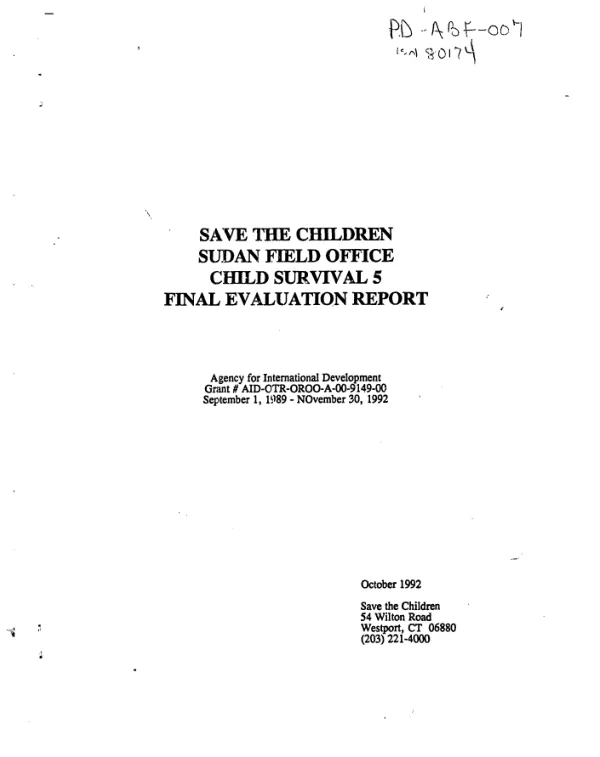
Save the Children Sudan field office : child survival 5 -- final evaluation report
Final report on a grant (9/89-11/92) to Save the Children Federation (SCF) to conduct child survival activities in Sudan"s Eastern and Kordofan States.
1992
Sign in to readA free account is required to download.
Abstract
SCF"s first step was the compilation of family rosters through home visits by trained village volunteers. These rosters were computerized and used for targeting at-risk populations (malnourished children, pregnant women), and for monitoring and following up on interventions. The rosters are continually updated and form the basis of the project"s information system. Future information efforts will focus on increasing communities" awareness of and responsibility for health information. SCF has worked closely with the Ministry of Health (MOH) at all levels and is currently implementing the MOH immunization program in 34 villages. The MOH is committed to providing a reliable source of vaccines, and SCF will be working with village health committees to take on their own vaccine transport and increase their responsibility for monitoring the program. Mothers are being trained informally to use oral rehydration salts (ORS) and fluids available at home to combat diarrhea as soon as it starts. Referral of prolonged cases and continued feeding and breastfeeding both during and after diarrhea are also being urged. SCF distributes ORS sachets -- 10,000 the last project year alone -- which are provided by the MOH free of charge, although there seems to be a community willingness to pay for them. The possibility of adding a slight charge, which SCF believes would improve the appropriateness of ORS use, will continue to be explored. Nutrition efforts have focused on informal education of mothers and demonstrations of locally available foods. Mothers" ignorance regarding breastfeeding and weaning practices was found to be a major cause of malnutrition in children aged 6-35 months, with lack of food and poor food hygiene as contributing factors. Growth monitoring has been discontinued as a primary focus of the nutrition program, although it will continue to be used as an evaluation tool. The project recently began providing Vitamin A supplements to children under age 3 and lactating mothers. It has been impossible so far to implement child spacing due to the sensitivity of the issue. However, SCF trainers have now gained a level of trust with villagers and are ready to begin a very conservative program which stresses the health benefits of child spacing and identifies sites for distribution of supplies. With malaria endemic and medicine in short supply, SCF has instituted a chloroquine revolving fund; it is currently in place in the four villages where there are MOH workers and should be extended to the remaining villages in the coming year with the help of VHC"s. The latter have been established in each village in which SCF is working and form, along with the MOH-appointed community health workers, the basis for the long-term sustainability of the program. Finally, a survey was conducted 8-9/92 of the knowledge and practice of mothers of children under age 2 in regard to nutrition, malaria, diarrhea disease control, immunization, maternal care, child spacing, and water and sanitation. In general, survey results showed higher than national rates. (Complete findings are included in this report.)
![Wawa sana [healthy child] : mobilizing communities and health services for community-based IMCI [integrated management of childhood illnesses] -- testing innovative approaches for rural Bolivia : Bolivia CS-16 -- final evaluation](https://covers.devme.ai/gen/5038.webp)