USAID DEC
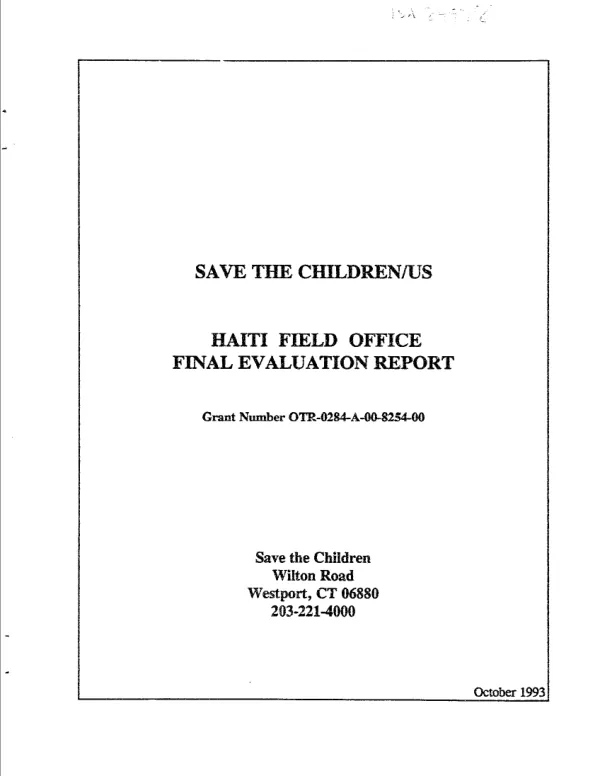
Save the Children/US Haiti field office final evaluation report, grant number OTR-0284-A-00-8254-00
Sign inSAVE THE CHILDREN (U.S.)
Save the Children/US Haiti field office final evaluation report, grant number OTR-0284-A-00-8254-00
Final evaluation of a project (12/88-9/93) to reduce Vitamin A deficiency among children in Haiti"s Maissade area.
1993
Sign in to readA free account is required to download.
Abstract
The project, implemented by Save the Children (SCF), achieved success through an innovative approach combining the elements of: a defined, registered population with identification of high-risk individuals; community-based distribution of Vitamin A capsules; promotion of home gardens with Vitamin A-rich plants; training of mothers in appropriate feeding practices stressing Vitamin A-rich foods; and creation of women"s groups with a focus on income generation. The project carried out an informative baseline survey which documented significant findings on child health and nutrition; these findings were used in program planning. Also, SCF developed a useful field method of assessing Vitamin A risk and monitoring Vitamin A consumption. More importantly, intensive growth monitoring activities (94% of children under 5 have a growth monitoring card and 60% were weighed within the 3 months preceding the evaluation) suggest that the project has the means to identify malnourished children. Project achievements were based on a dual approach which emphasized increased access to Vitamin A as well as increased maternal knowledge. Compared with baseline data, the percentage of children aged 6 months to 6 years who had received a Vitamin A capsule within the last 4 months increased from 26% to 60%, and a significant number of home gardens containing Vitamin A-rich food were begun. Some 56% of mothers had knowledge of at least one Vitamin A-rich food, and practically all children at risk of Vitamin A deficiency had received one Vitamin A capsule within the 6 months prior to project evaluation. While few mothers in the general population could explain accurately why Vitamin A was important, members of special women"s groups and mothers who participated in the "roving nutrition centers" generally understood the importance of Vitamin A. The project effectively used data for decisionmaking. The Health Information System is population-based, all families being registered. This allows for identification of areas where coverage is low and of individual children who do not use services. Coverage data are routinely monitored and fed back to project staff (health agents and nutrition monitrices). Efforts to extend this feedback process to community groups have been initiated. The project has developed a systematic approach to combating childhood malnutrition which involves comprehensive growth monitoring and the use of the roving nutrition centers to rehabilitate malnourished children and teach proper child feeding practices. While the centers were shown to benefit some two-thirds of the children attending them, resources were insufficient for extending them to the entire population. As a result, the nutritional status, project-wide, of children under 5 did not seem to improve during the project. The project successfully integrated the Vitamin A programs into other child survival activities and, while lacking an explicit sustainability objective, laid the groundwork for sustainability by increasing mothers" knowledge of Vitamin A-rich food. Were SCF to cease all activities in the Maissade area, some of this maternal knowledge would remain, as would an increased understanding of inexpensive ways of incorporating Vitamin A-rich foods into the family diet. The task of making Vitamin A capsules available to all children would fall back on Ministry of Health personnel. (Author abstract, modified)
![Child Health Institute (CHI) and International Child Care (ICC) : final evaluation of the child health project -- ICC/CAT-PSC, Zone III -- area of Nippes [Haiti]](https://covers.devme.ai/gen/6069.webp)