USAID DEC
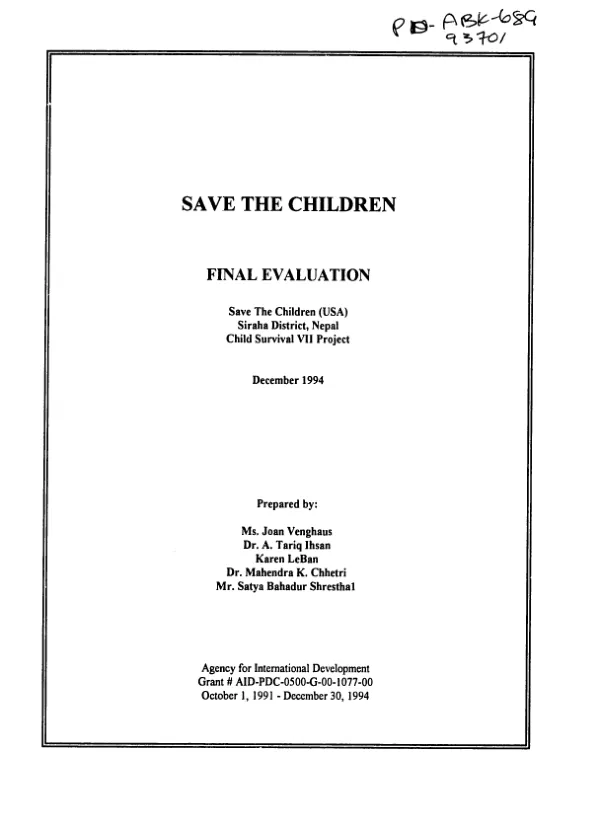
Save the Children (USA) : child survival VII project, Siraha District, Nepal -- final evaluation
Sign inSAVE THE CHILDREN (U.S.)
Save the Children (USA) : child survival VII project, Siraha District, Nepal -- final evaluation
Final (internal) evaluation of a Save the Children Federation (SCF) child survival project (10/91-12/94) in Nepal's Siraha District.
Venghaus, Joan|Ihsan, A. Tariq · 1994
Sign in to readA free account is required to download.
Abstract
The project focused on strengthening the Ministry of Health's (MOH) service delivery system and improving knowledge and practice of protective health behaviors at the household level. Despite its short duration, the project had a substantial impact on the community at large. Thanks to a clear identification of health priorities at the start of the program, notable success was achieved in mobilizing the communities and establishing community-based management structures. Another commendable success was the strong link that developed between nonformal education activities, community health, and the empowerment of women. Attainment of literacy has contributed to a rise in the status of women through income generation activities and increased self-reliance. There has been a substantial improvement in antenatal care and higher utilization of traditional birth attendants. Management of diarrheal diseases, which are quite prevalent in the project area, was greatly enhanced, and improvements were noted in the areas of tetanus toxoid coverage, acute respiratory infection and treatment, and awareness of the expanded immunization program. The project also incorporated a phasing-over strategy by revitalizing health post and outreach clinic management committees as a vehicle for continuing project services on a cost recovery basis. On the negative side, most of the measures recommended by the midterm evaluation were not incorporated into the project, resulting in the persistence of the problems which arose during the first half of the project. Another weakness was the project's length; 3 years is far too short a time frame to accommodate the complexity of this project and does not allow the flexibility needed to adjust to unanticipated events. Additionally, because the MOH -- which was to work closely with SCF on project implementation -- was involved in the government planning standstill (a result of the political transition that lasted until 1992/3), many project objectives could not be achieved. Thus, it is important to consider the host country's political scenario and to clearly define the host country's responsibilities regarding project implementation during project planning.
Related documents