USAID DEC
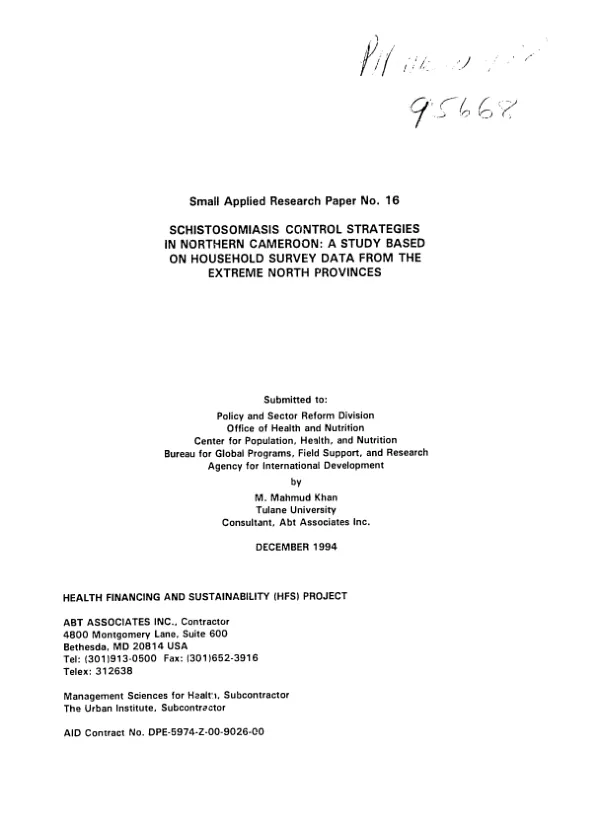
Schistosomiasis control strategies in northern Cameroon : a study based on household survey data from the extreme north provinces
Sign inABT ASSOCIATES, INC.
Schistosomiasis control strategies in northern Cameroon : a study based on household survey data from the extreme north provinces
This report builds upon work on schistosomiasis control conducted by Tulane University in northern Cameroon, including a pilot project undertaken with the Cameroonian Ministry of Public Health in 1990.
Khan, M. Mahmud · 1994
Sign in to readA free account is required to download.
Abstract
The study analyzes data collected from this same pilot project and from a 1993 household survey, supported by the Health Financing and Sustainability (HFS) Project, regarding knowledge of the disease, sources of water supply, water contact behavior, and willingness and ability to pay for various control interventions. The cost of diagnosis and treatment of schistosomiasis are explored, as well as the costs of snail control and health education programs. A household"s willingness to pay for control programs depends on the subjective evaluation of costs associated with the infection, the prevalence rate, and the risk of contracting the disease. Costs associated with the disease increase with intensity. Since low-intensity infections are often ignored, only cases of moderate to severe infection will encourage participation in schistosomiasis control programs. In general, about 50% of the households surveyed are directly affected by the infection during a 12-month period. Since fewer than 50% of all infections are classified as moderate to severe in intensity, it is not surprising that fewer than 30% of individuals diagnosed with schistosomiasis actually sought treatment during 1991-92. The 10% prevalence rate obtained by the results of the 1993 survey is not sufficiently high to generate community interest in control programs. With a prevalence rate that approaches at least 18%, community management, financing, and implementation of schistosomiasis control programs would be politically feasible. Given the general prevalence rate of only 10% estimated for this region of northern Cameroon, policymakers are recommended to focus their efforts on diagnosis and treatment of the infection. (Author abstract)
Related documents
Documents in this collection
 2000
2000USAID DEC
Health financing policy reform in Tanzania : payment mechanisms for poor and vulnerable groups in Korogwe District
Open record 1994
1994USAID DEC