USAID. BUR. FOR SCIENCE AND TECHNOLOGY. OFC. OF NUTRITION
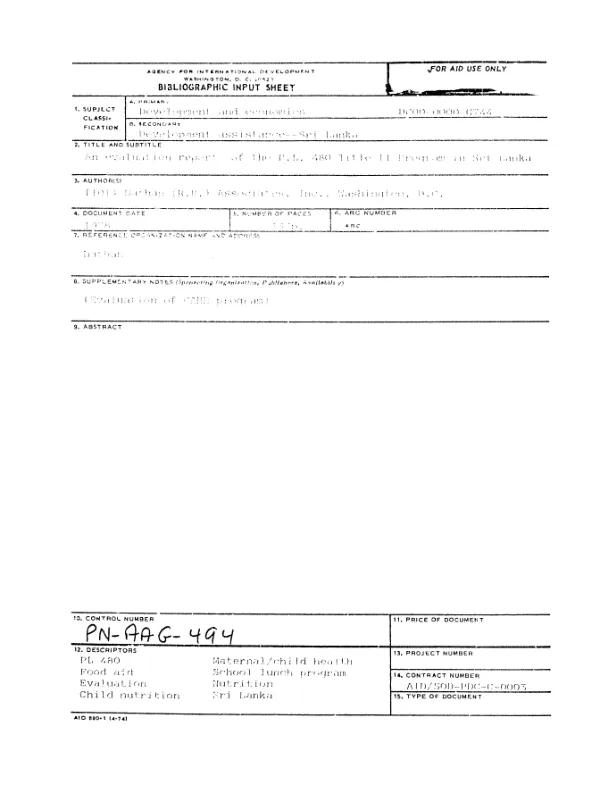
School feeding : effects on enrollment, attendance, and drop-out in Sri Lanka
Evaluates P.L.
Miller, Roy I.; Drake, William D. · 1983
Sign in to readA free account is required to download.
Abstract
48O Title II school feeding program administered by CARE in Sri Lanka. Evaluation, focusing on the program"s effects on school enrollment, attendance, and drop-out rates, is based on surveys of sample schools. The evaluation team designed a special survey in which the records of 112 schools (59 of which had participated in feeding programs) were sampled throughout 1980; the schools were drawn from 21 regions in 19 of the 24 administrative districts of Sri Lanka. Simultaneously, the team worked with CARE/Sri Lanka to design a second, independent survey covering 25 schools in 2 districts over a 3-year period; 21 of the latter schools had participated in the school feeding program. Following are the major findings. (1) Overall, the data suggest that enrollment and attendance in the lower grades is enhanced by school feeding, but that school feeding is not related to the short run decision to attend school on a particular day or given month. (2) During every month in 1980, attendance in non-feeding schools was higher than in feeding schools. Moreover, in the data collected by CARE there is no relationship between attendance and the presence or absence of feeding in the schools. (3) Drop-out rates throughout the elementary school grades in feeding schools are somewhat lower than the rates in non-feeding schools. Using the CARE data, a positive relationship between school feeding and enrollment in the elementary grades is also indicated. (4) In both the 6th and 7th grades, drop-out rates are higher in feeding schools than in non-feeding schools. In the CARE data, losses in enrollment between the 5th and 6th grades are lower in feeding schools than in non-feeding schools. It is concluded that although school feeding is important, it is a relatively minor determinant of school attendance and/or enrollment. The survey results could also be attributable to other important factors: (1) Sri Lanka"s historical, cultural, and familial incentives to enroll and stay in school, which mitigate against school feeding being a large determinant of attendance and enrollment; (2) seasonal variations, climatic variations between years, and variations by geographic region; and (3) migration patterns, which vary by region and by age of child. Another useful measure of the effects of feeding may be fluctuations in attendance, which should be calibrated in future studies. It is recommended that a series of small, narrowly defined studies be undertaken with the objective of detecting any possibility that school feeding contributes to the nutrition and/or education of school children. (Adapted from ANE Executive Summary, PD-AAT-669, pp. 137-138)