RAND CORP.
SCHOOLING, ALLOCATIVE ABILITY AND THE GREEN REVOLUTION
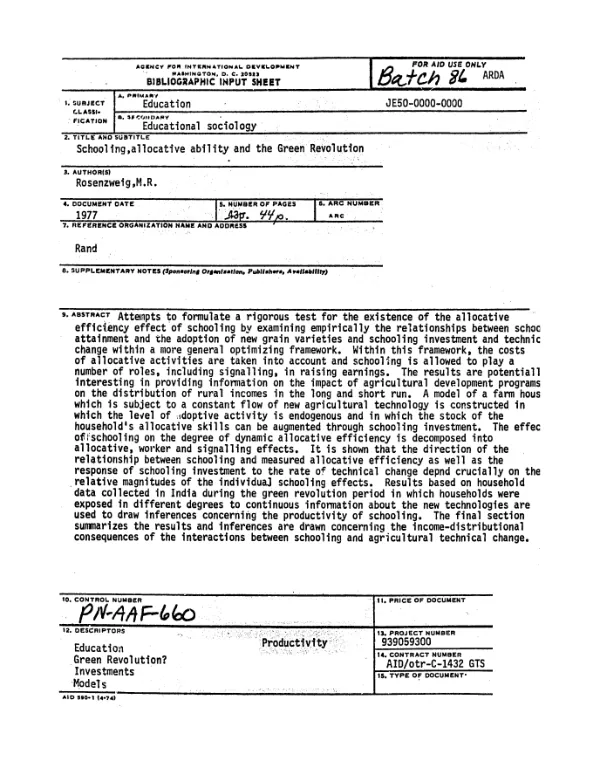
Attempts to formulate a rigorous test for the existence of the allocative efficiency effort of schooling by examining empirically the relationships between schooling attainment and the adoption of new grain varieties and schooling investment and technical change within a more general optimizing framework.
ROSENZWEIG, MARK R. · 1970
Sign in to readA free account is required to download.
Abstract
Within this framework, the cost of allocative activities are taken into account and schooling is allowed to play a number of roles, including signalling, in raising earnings. The results are potentially interesting in providing information of the impact of agricultural development programs on the distribution of rural incomes in the long and short run. A model of a farm household which is subject to a constant flow of new agricultural technology is constructed in which the level of adoptive activity is endogenous and in which the stock of the household"s allocative skills can be augmented through schooling investment. The effect of schooling on the degree of dynamic allocative efficiency is decomposed into relationship between schooling and measured allocative efficiency as well as the response of schooling investment to the rate of technical change depend crucially on the relative magnitudes of the individual schooling effects. Results based on household data collected in India during the green revolution period, in which households were exposed in different degrees to continuous information about the new technologies, are used to draw inferences concerning the productivity of schooling. The final section summarizes the results and inferences are drawn concerning the income-distributional consequences of the interactions between schooling and agricultural technical change.
Related documents
Documents in this collection
 1980
1980USAID DEC
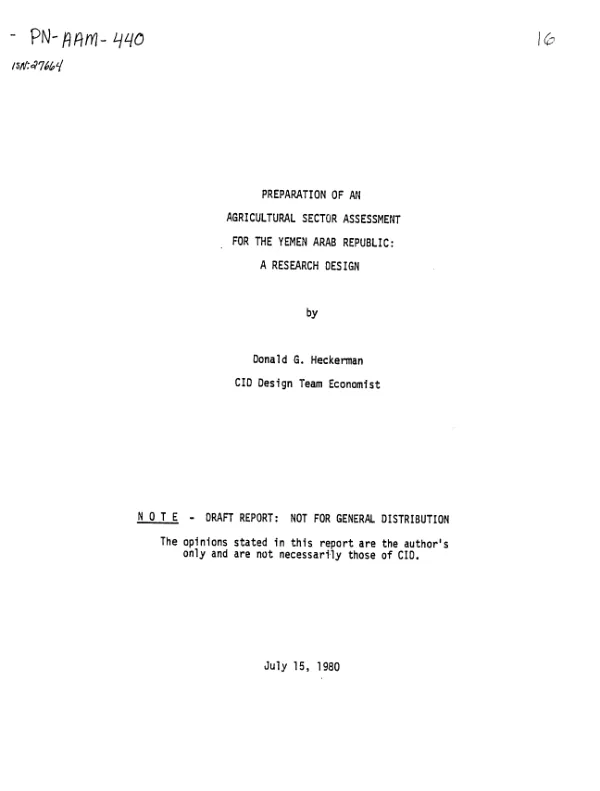
Preparation of an agricultural sector assessment for the Yemen Arab Republic : a research design
Open record 1970
1970USAID DEC