USAID DEC
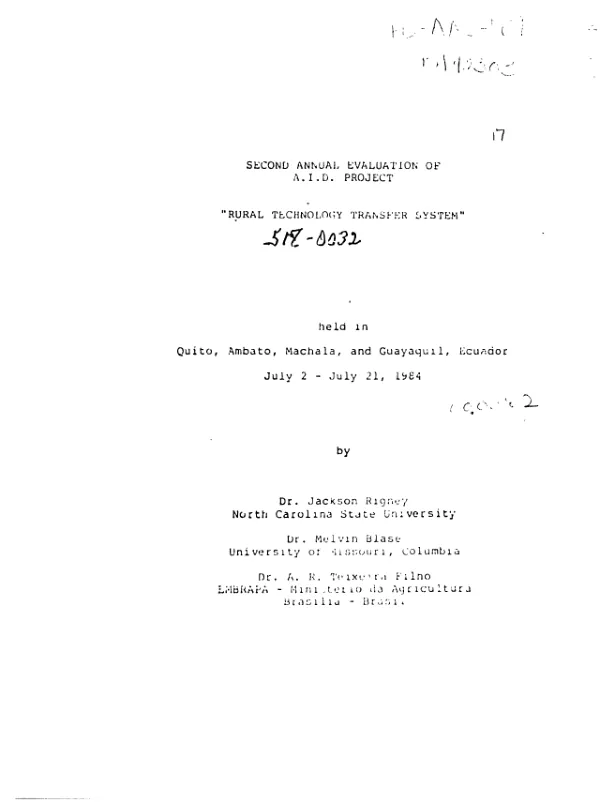
Second annual evaluation of AID project `rural technology transfer system' : held in Quito, Ambato, Machala, and Guayaquil, Ecuador
Sign inUSAID. MISSION TO ECUADOR
Second annual evaluation of AID project `rural technology transfer system' : held in Quito, Ambato, Machala, and Guayaquil, Ecuador
Evaluates project in Ecuador to strengthen rural institutions, disseminate small farm technologies, and establish a Rural Technology Transfer System (RTTS).
Rigney, Jackson|Blase, Melvin|Filho, A. R. Teixeira · 1984
Sign in to readA free account is required to download.
Abstract
Special evaluation covers the period 1980-84 and is based on document review, site visits to 10 of 12 subprojects (SP's), and interviews with USAID, SP, administrative, and technical personnel. While its basic objective remains sound, the project's design was overly ambitious, unrealistic, and at times almost self-destructive. Project administration and financing have been most ineffective. CONACYT, the implementing agency, was established after project approval and did not participate in the project's design; as its operations got underway, CONACYT found the requirements for TA and training too stringent and inflexible, and felt that it did not have the necessary flexibility to adapt SP's to the priority needs of Ecuador. As a result, CONACYT has virtually ceased to approve any kind of TA or training for the past year and a half, and has prevented the University of Florida from performing its function. In addition, the project plan to establish informal collaborative linkages among rural institutions required an implementing agency with strong administrative, planning, and technical capacity; it was unrealistic to expect CONACYT, a new institution, to have these capacities, or the Government of Ecuador to be able to provide sufficient counterpart funds. TA in the SP's has been effective at the technician level but has been less so at the level of top management and administration. Training has been uneven and too closely tied to specific SP's; the lack of management training at CONACYT has also limited the quality of training in the SP's. Nonetheless, some positive results in institution building are evident among the 12 SP's. Funds for private sector research have not yet been used. A major redesign is strongly recommended to: focus on technical training (in-country and U.S. short-term and degree training and English language training); specify a limited number of institutions for investment and to form the primary advisory council; strengthen appropriate SP's; create a follow-on SP to the Machala University brucellosis SP; reconstitute the administrative services agency and the technical services contract; select a new lead institution; establish a training SP; and identify research priorities as they relate to redesigning the project.
![Evaluation of USAID/Ecuador - WASHED [water and sanitation for Ecuadorian health and development] project](https://covers.devme.ai/gen/7909.webp)