USAID DEC
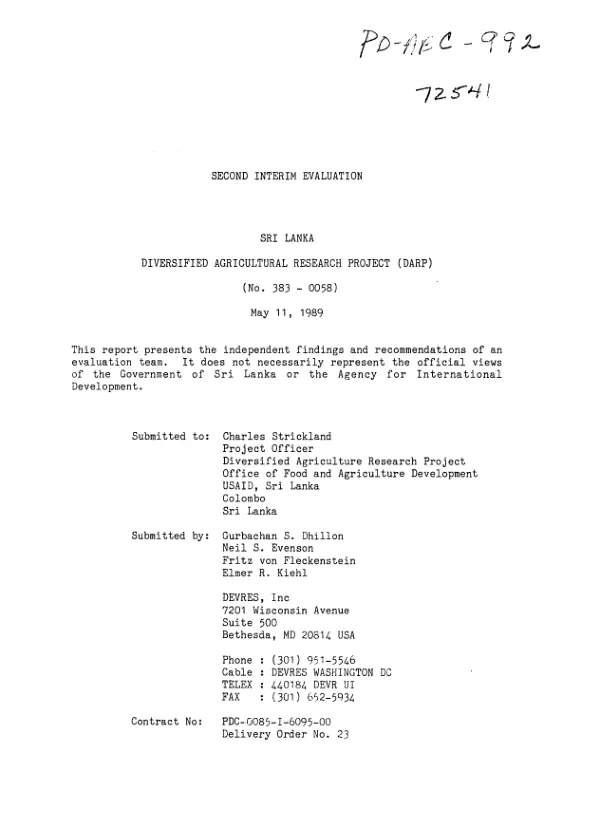
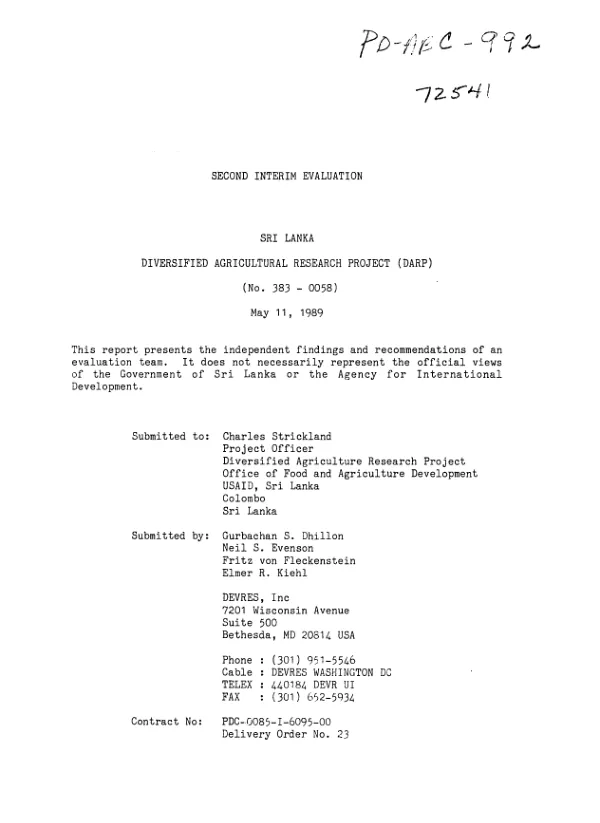
Second interim evaluation : Sri Lanka -- diversified agricultural research project (DARP) (no. 383-0058)
Sign inDEVRES, INC.
Second interim evaluation : Sri Lanka -- diversified agricultural research project (DARP) (no. 383-0058)
Evaluates a project to strengthen the Sri Lankan Department of Agriculture's (DOA) capacity to develop and transfer to small farmers the improved technologies and inputs needed to produce subsidiary food crops (SFC's -- coarse grains, oilseeds, pulses).
Dhillon, Gurbachan S.|Evenson, Neil S. · 1989
Sign in to readA free account is required to download.
Abstract
Interim evaluation covers the period 10/87-5/89. Results have been mixed. The scope and quality of the activities undertaken to support and strengthen the DOA has been impressive. Despite the weak economic situation, the capabilities of the principal actors in the DOA have been improved considerably. Long-term training is proceeding satisfactorily despite serious earlier problems in split degree programming and management between DOA and the University of Peradeniya's Post Graduate Institute for Agriculture. Short-term training, workshops, and seminars have been effective in supporting project objectives. Good progress has been achieved in the seed production, processing, and distribution component, and a momentum for commercialization has been established. Social and economic research studies are underway and have had a significant impact; no whole-farm studies have been conducted, however. Agronomic and SFC research has been extensive, though little farming systems research has been conducted. Also, on the positive side, DOA workplans have become an effective instrument for project management, and revitalization of the Regional Technical Working Group has greatly strengthened collaboration between research and extension, and helped improve the programming of both. Both the TA contractor, Development Alternatives, Inc., and the training contractor, Institute of International Education, have provided innovative and effective assistance. Achievements have been less than expected in certain areas. Procedures of the Government of Sri Lanka's (GOSL) Tender Board have slowed procurement and construction elements, and civil disturbances have caused construction targets to be reduced from 7 regional research centers (RRC's) and 5 seed farm/processing centers (SF/PC's) to 5 RRC's and 4 SF/PC's). Also, the new crop varieties developed under the project have not been released, and research results and manuals have been written but not packaged for extension. These problems have largely stemmed from unfulfilled assumptions concerning (1) GOSL capability for timely financial and personnel support, (2) collaboration between DOA divisions, and (3) the DOA's ability to effectively organize and program the shift to SFC. Political instability has been a deterrent in several aspects. In sum, the project has been successfully launched, and investments made so far are on the threshold of yielding significant returns. Given the project's unrealistically short time-frame, a 2-year extension is considered critical. Two lessons were learned. (1) A shift in research emphasis requires considerable restructuring for a national system, and takes more time and resources than is generally supposed. (2) Projects with a mix of TA and large facilities' construction are likely to be hindered by delays; introducing unfamiliar procedures exacerbates these problems.