FOUNDATION FOR AGRICULTURAL DEVELOPMENT
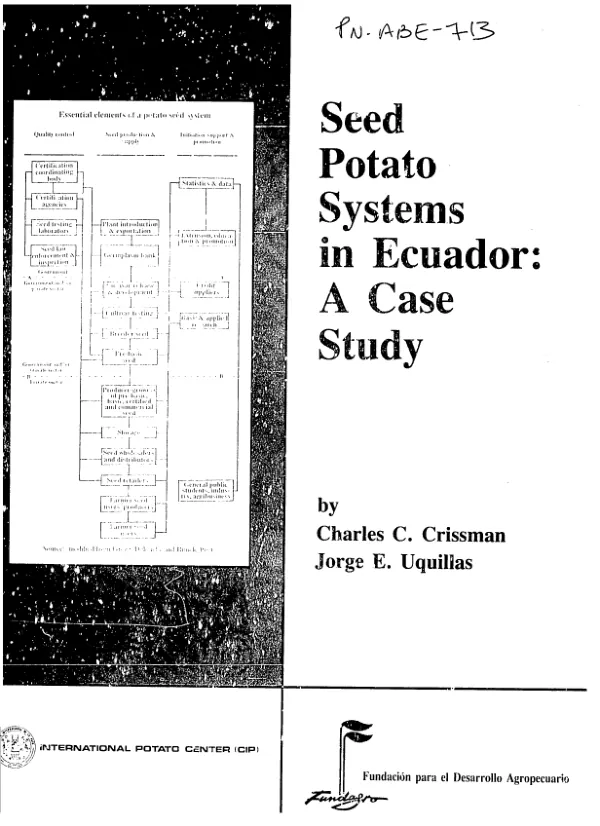
Seed potato systems in Ecuador : a case study
Ecuador"s potato seed program is the subject of this case study.
Crissman, Charles C.; Uquillas, Jorge E. · 1970
Sign in to readA free account is required to download.
Abstract
Major findings are as follows. (1) Potato production is dominated by small farmers in the sierra (highlands) and is largely market-oriented. (2) Seed from the informal sector accounts for 99% of seed demand. The technology of seed production, storage, management, and marketing in this sector appears unchanged over the last four decades. (3) The formal seed program, which is administered by three Ministry of Agriculture agencies, is significantly underfunded and suffers from poor interagency coordination and an inadequate distribution system. (4) The official program"s largest impact has been in the development of improved varieties which have been diffused by the informal seed system. (5) Although the development of a rapid multiplication system for pre-basic seed production has substantially improved the health quality of official seed, the impact of the system has been minimal due to the absence of an effective system for further multiplication and distribution. Moreover, recent research suggests that variety and location are more important than seed health in determining potato yields and profitability. (6) An alternative model of low volume, widely dispersed distribution designed to take advantage of natural seed production areas appears to be a promising way to connect the official and the informal seed systems.
Connected topics