 1970
1970USAID DEC
MISSISSIPPI STATE UNIVERSITY. SEED TECHNOLOGY LABORATORY
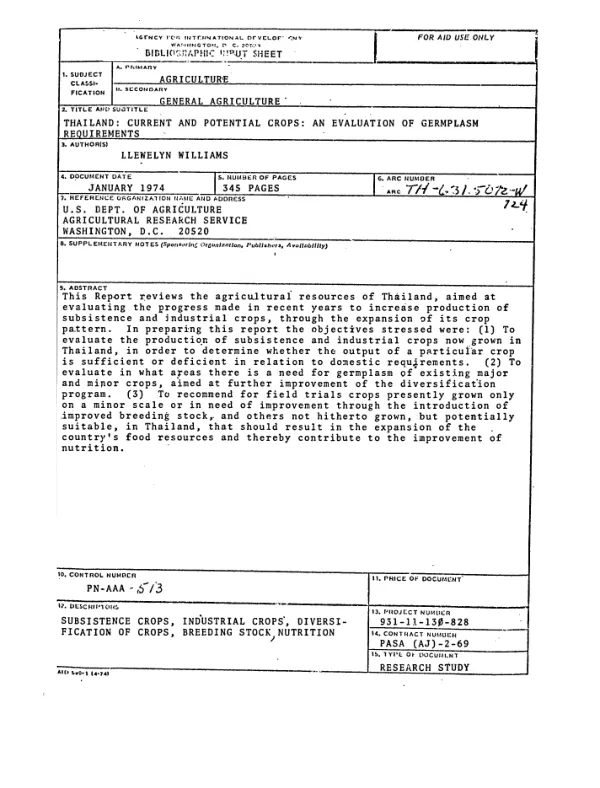
One of the objectives of Thailand"s Third National Economic and Social Development Plan (1972-1976) is the development of a seed program that will assure Thailand"s farmers of a continuous supply of high quality seed of improved varieties at reasonable prices.
1970
Abstract
For several years the Department of Agricultural Technology (DAT), Ministry of Agriculture and Cooperatives (MOAC), has produced and distributed limited quantities of "foundation" class seed to "key" farmers through a joint program with the Department of Agricultural Extension (DOAE). This program has not had sufficient impact on the kind and quality of seed planted in Thailand. During 1972, the decision was made to establish a program which would increase the supply of high quality seed and encourage more active participation of the private sector in supplying seed of Thailand"s basic crops: rice, maize, soybeans, castor beans, kenaf, mungbeans, cotton and peanuts. Responsibility for development and implementation of the program to achieve these goals was assigned to the DOAE. Soybeans were selected to be the initial focus crop of the new program with maize seed to be included during 1974. Under the cooperative program between the DOAE and the United States Overseas Mission to Thailand (USOM), the services of two consultants were requested by USOM/T to advise DOAE on seed program/industry development and to assist with several technical aspects of the program that were in urgent need of attention. Mississippi State University (MSU) nominated two specialists for the assignment: Howard C. Potts (seed program development) and George M. Dougherty (seed processing). Potts was on assignment in Thailand from 24 April through 7 June and Dougherty from 13 May through 28 June.
Connected topics
Classification
USAID DEC