CENTERS FOR DISEASE CONTROL (CDC) (U.S.)
SEROLOGIC DIAGNOSIS OF MALARIA; FINAL REPORT
Microscopists in malaria programs examine millions of blood slides each year.
1970
Sign in to readA free account is required to download.
Abstract
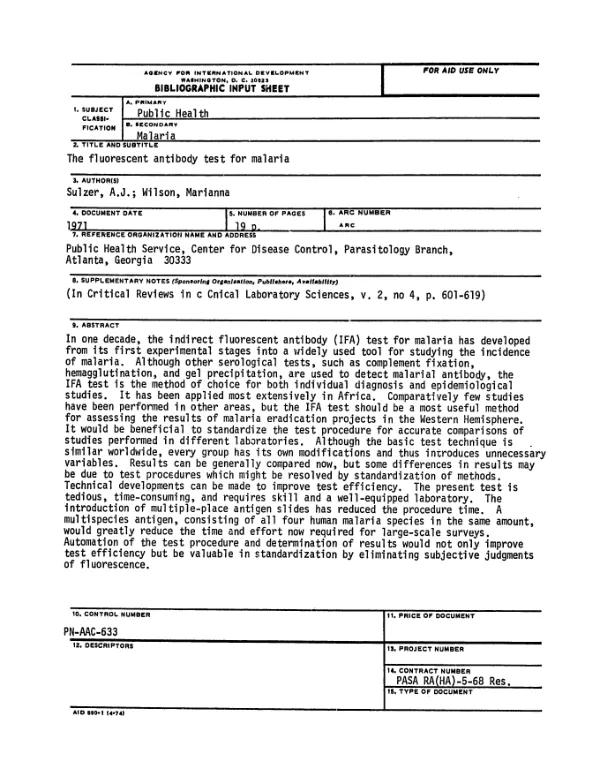
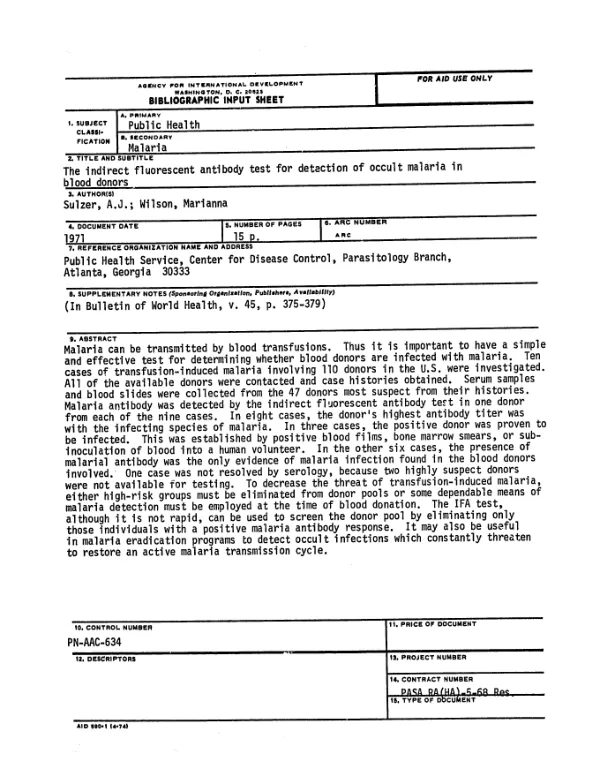
In areas with a low incidence of infection, few positive blood films are found, and more sensitive epidemiologic tools are needed. The main objective of the project was to develop simple, rapid, accurate methods for the serologic diagnosis of malaria for use in malaria programs. Diagnostic techniques based on malaria serology were known in principle, but were not developed for field use to meet the large scale case finding and investigational needs of malaria programs. The use of the indirect hemagglutination (IHA), indirect flurescent antibody (IFA), and complement fixation (CF) tests and other serologic techniques had to be examined. Another objective was to produce antigens from monkey and human malarias and to evaluate the sensitivity and specificity of such antigens for the diagnosis of human malaria. The third objective was to determine the operational use of serologic techniques for epidemiologic and diagnostic purposes.
Connected topics
Related documents