LONDON SCHOOL OF HYGIENE & TROPICAL MEDICINE
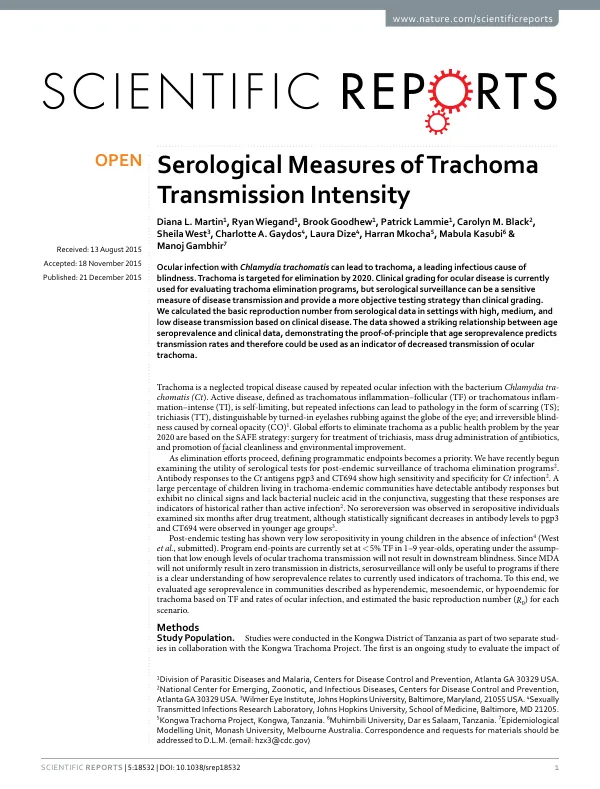
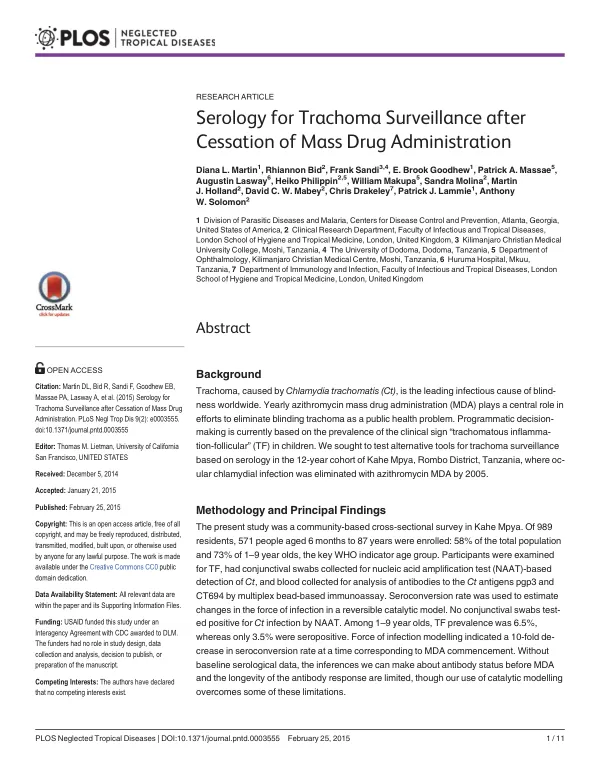
Serology for Trachoma Surveillance after Cessation of Mass Drug Administration
Trachoma, caused by the bacterium Chlamydia trachomatis (Ct), is the leading infectious cause of blindness worldwide.
2015 · 11 pages
Sign in to readA free account is required to download.
Abstract
The infectious agent can be treated with a single oral dose of azithromycin, which is a cornerstone of programs dedicated to the elimination of trachoma as a public health problem. Azithromycin mass drug administration (MDA) is a critical component of the strategy for Global Elimination of Trachoma by 2020 (GET2020), recommended where the prevalence of trachomatous inflammation-follicular (TF) is 10% or more in children aged 1-9 years. The current WHO endpoint for cessation of community-based antibiotic treatment is a TF prevalence in 1-9 year-olds of less than 5%. However, prevalence surveys illustrate that signs of active trachoma, TF and TI, exceed Ct infection rates. Follicular or intense conjunctivitis may be caused by non-chlamydial bacteria, with the relative importance of this phenomenon probably increasing after populations begin to receive azithromycin MDA. The examination process can be difficult to standardize, and inter-observer agreement is often sub-optimal. A post-elimination surveillance methodology with greater reliability than clinical examination is needed to allow programs to identify and respond to recrudescent infection. Recent efforts to evaluate serology as a viable option for post-MDA surveillance identified tests using two previously-described chlamydial antigens, pgp3 and CT694, as having high sensitivity to detect current ocular infection, and high specificity using non-endemic controls. The age-specific prevalence of serological responses to Ct antigens at community level could provide an informative proxy measure of intensity of transmission and an early indicator of transmission recrudescence. The study was conducted in the Tanzanian community of Kahe Mpya, Rombo District, where high coverage azithromycin MDA was delivered in 2000 and 2002, and topical tetracycline ointment treatment was given to individuals with active trachoma. Elimination of ocular Ct infection by 2005 was previously documented. The study aimed to examine the use of serological tools for monitoring and evaluation in a post-MDA setting by assessing the age-specific prevalence of signs of trachoma and Ct-specific antibody responses within the community. A community-based cross-sectional survey was conducted in Kahe Mpya, with 571 people aged 6 months to 87 years enrolled, representing 58% of the total population and 73% of 1-9 year olds, the key WHO indicator age group. Participants were examined for TF, had conjunctival swabs collected for nucleic acid amplification test (NAAT)-based detection of Ct, and blood collected for analysis of antibodies to the Ct antigens pgp3 and CT694 by multiplex bead-based immunoassay. Seroconversion rate was used to estimate changes in the force of infection in a reversible catalytic model. No conjunctival swabs tested positive for Ct infection by NAAT, and among 1-9 year olds, TF prevalence was 6.5%, whereas only 3.5% were seropositive. Force of infection modelling indicated a 10-fold decrease in seroconversion rate at a time corresponding to MDA commencement. The study suggests that the age-specific prevalence of antibody responses may be of use to programs seeking to demonstrate the impact of interventions against trachoma. Serologic tests support NAAT findings of very low to zero prevalence of ocular Ct in this community and have potential to provide objective measures of transmission and useful surveillance tools for trachoma elimination programs.
Related documents
Documents in this collection
 2023
2023USAID DEC
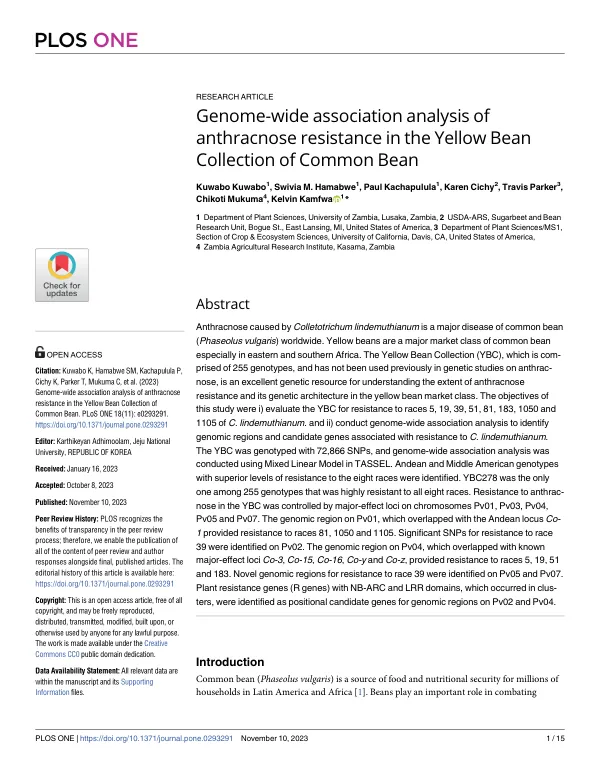
Genome-wide association analysis of anthracnose resistance in the Yellow Bean Collection of Common Bean
Open record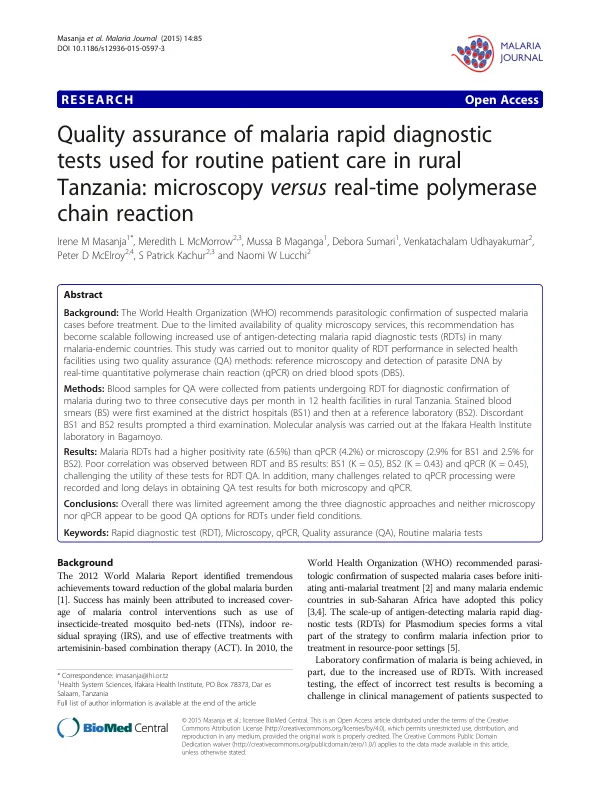 2015
2015USAID DEC
Quality assurance of malaria rapid diagnostic tests used for diagnostic confirmation of malaria in rural Tanzania: microscopy versus real-time polymerase chain reaction
Open record