USAID. BUR. FOR RESEARCH AND DEVELOPMENT. OFC. OF POPULATION
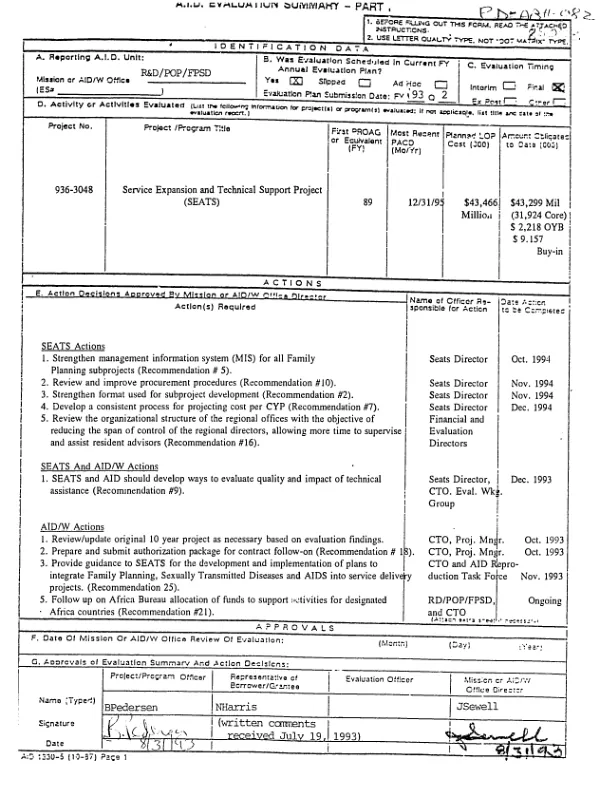
Service expansion and technical support project (SEATS)
Summarizes final evaluation (PD-ABG-637) of a project to support family planning (FP) subprojects in low contraception prevalence countries (SEATS project).
1993
Sign in to readA free account is required to download.
Abstract
Evaluation covered the period 1989-8/93, against a PACD of 7/94. The project is being implemented by John Snow, Inc. The project has reached all its targets, including (1) 43 relatively large urban FP service subprojects, all of which serve substantial populations and encompass multiple sites, and half of which involve the private sector; (2) the provision of institution-building TA to FP programs in project development, contraceptive logistics, quality assurance, management information systems (MISs), nonclinical and clinical health worker training, health care financing, evaluation, and commodity procurement; and (3) undertaking of specialized activities until a Mission develops a bilateral program (bridging). Among the project"s strengths are its decentralized management structure, which has provided the flexibility needed to respond to a variety of country conditions and needs, and the recruitment of high-quality technical and managerial staff (most often from regional sources), who have been a prime factor in establishing project credibility. On the other hand, MIS development has been slow and procurement problems have occurred, sometimes for reasons beyond the project"s control. TA expenditures have been unexpectedly high as the project underestimated the needs of low-prevalence countries. In sum, the need for this type of FP project, which has a broad and flexible design and quick access to central funds, will continue beyond the current contract. It is recommended that the project be extended 5 years and that its design remain intact, although service delivery should be emphasized over institutional development. The following lessons were learned. (1) Missions, increasingly understaffed in the areas of health, population, and nutrition, need auxiliary assistance from projects like SEATS and resident advisors who can provide TA for a variety of activities. (2) The one-stop-shopping concept for TA makes more sense in low-prevalence countries such as Tanzania than in higher prevalence countries and more mature programs, where TA needs are more sophisticated and specialized. Even in low-prevalence countries, however, one-stop-shopping alone may not be sufficient because of the enormity of the task. (3) Although couple years of protection is a useful measure of aggregate achievement, it should not be the only indicator in establishing service delivery targets or evaluating performance at the subproject level. The evaluation team and the Office of Population agreed that insufficient time was devoted to the evaluation in light of the project"s complexity, diversity, geographic spread, paucity of objectively verifiable indicators, and the embryonic state of service delivery subprojects.
Related documents
![Assessment of the innovations in family planning services [IFPS] project : summary report](https://covers.devme.ai/gen/35782.webp)