USAID DEC
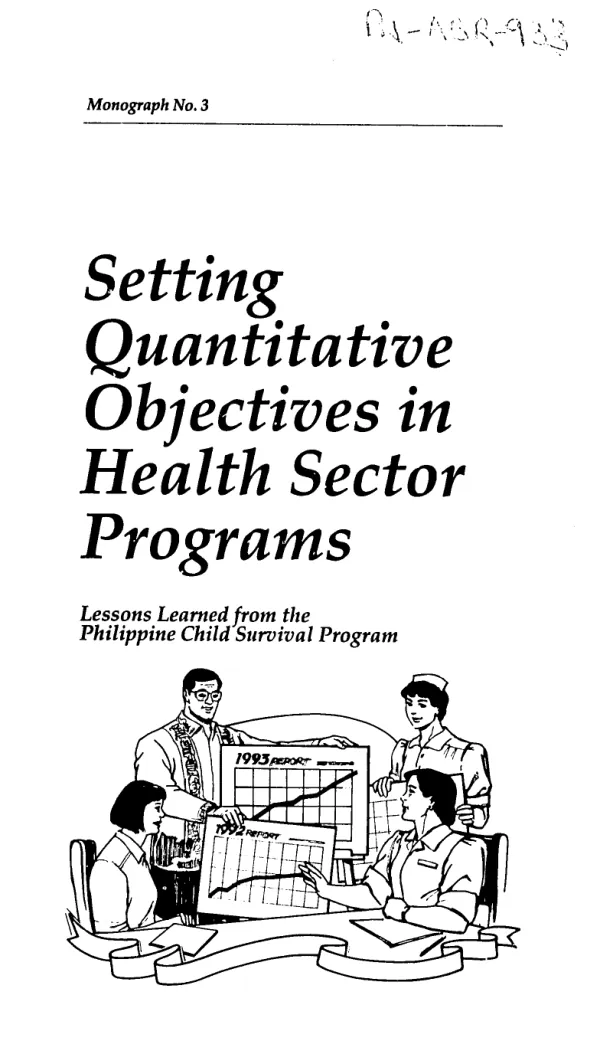
Setting quantitative objectives in health sector programs : lessons learned from the Philippine child survival program
Sign inPHILIPPINES. DEPT. OF HEALTH
Setting quantitative objectives in health sector programs : lessons learned from the Philippine child survival program
Clear and measurable objectives are an important management tool, particularly in health sector programs.
Loevinsohn, Benjamin P. · 1993
Sign in to readA free account is required to download.
Abstract
This paper examines the effect of setting quantifiable objectives (e.g., increasing the percentage of fully immunized infants from 65% to 85%) on the Philippine Child Survival Program (CSP) and what can be learned from the experience. The CSP objectives were output rather than impact indicators because the former are easier to measure and more directly related to the health system"s efforts. Establishment of quantitative indicators had a positive effect on managers" collection and use of data. For example, a new way of doing household surveys was created to measure the contraceptive prevalence rate. On the other hand, the CSP indicators did not appear to give a common direction to staff, because they were not widely known. The targets were infrequently used to make course corrections because baseline data were not readily available and because there were few occasions on which they were discussed by top management. The CSP experience suggests that: (1) much time and effort are needed at the beginning of a project to establish a few easily measured, epidemiologically valid, output indicators; (2) it is important to spend the small sums of money required to establish baseline figures for the selected targets; (3) for objective targets to lend a common direction to an organization they need to be widely circulated and discussed; (4) quantitative indicators need to be measured regularly, at least annually, and preferably more often; (5) reviews of progress toward accomplishing targets should take place at all levels of the organization, starting with top management. (Author abstract)
![Midterm evaluation of the quality assurance project [QAP] (cooperative agreement no. DPE-5992-A-00-0050)](https://covers.devme.ai/gen/7351.webp)
![Midterm evaluation of the quality assurance project [QAP] (cooperative agreement no. DPE-5992-A-00-0050)](https://covers.devme.ai/gen/36071.webp)