AECOM INTERNATIONAL
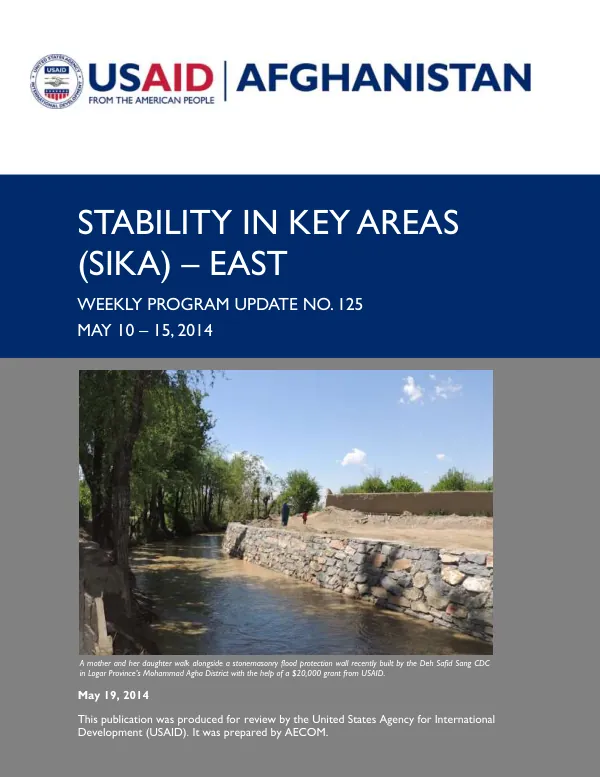
SIKA-East Weekly Program Update: May 10 – 15, 2014
Stability in Key Areas (SIKA) – East is a program aimed at promoting stability and development in five provinces of Afghanistan.
2014 · 8 pages
Sign in to readA free account is required to download.
Abstract
The program is implemented by the Ministry of Rural Rehabilitation and Development (MRRD) in partnership with the United States Agency for International Development (USAID). The program's primary objective is to improve the living conditions of the local population by providing infrastructure, economic opportunities, and social services. The program's activities are focused on five key areas: Participatory Community Development, Increased Engagement of District Officials, Radio Play, Advocacy, and Capacity Building. In the area of Participatory Community Development, the program conducted a five-day training for District Social Workers (DSWs) in Kabul, covering topics such as community engagement and participatory planning. The training was attended by 41 men and one woman, including all the DSWs from SIKA-East's original 21 targeted districts. The program also continued to engage district officials in the monitoring of SIKA-East projects in all five provinces. District Governors, members of District Development Assemblies (DDAs), DSWs, and other district officials participated in the monitoring process, which included the establishment of GIRoA-led monitoring committees consisting of representatives from the Provincial Governor's Office, PRRD, the District Governor's Office, and the Provincial Development Council. In the area of Radio Play, the program reviewed the Scope of Work of the radio play contract for Paktya Province in the light of USAID's comments. The contract is expected to be signed soon. The program also conducted a Training of Trainers (ToT) refresher in Advocacy for the field communication officers on May 13 and 14. Capacity Building is another key area of focus for the program. During the week, five training sessions were conducted for 52 men in four districts, covering topics such as Infrastructure Project Implementation, Grants Management, and Operation and Maintenance. In addition, an Advocacy ToT refresher was conducted in Kabul for the field communication officers. The program's Grants and Engineering activities are also noteworthy. During the week, ten projects worth nearly $280,000 were completed in five districts. One grant award valued at over $52,000 was made for a project in Khoshi District. Eighteen milestone payments valued at over $108,000 were made to projects in 12 districts. To date, 228 projects with a total value of over $8.1 million have been awarded to 20 districts in five provinces. The program's expansion into Muqur District in Ghazni Province is also significant. In March, USAID approved the expansion, and on May 12, the PRRD Director and SIKA-East Manager for Ghazni held a Stakeholder Planning Meeting in Ghazni City to introduce SIKA-East to important figures from Muqur. The meeting was attended by 15 people, including the District Governor, members of the Muqur DCC and DDA, representatives of DoWA and local CDCs, and other influential men and women from the area. In terms of gender activities, the program launched an improved, gender-sensitive stakeholder engagement process in new districts in SIKA-East's existing provinces. In Ghazni, Maydan Wardak, and Khost, Department of Women's Affairs (DoWA) representatives are now included in outreach, and female survey teams have been formed. In Khost's Nadir Shah Kot district, male DDA members and tribal elders participated in the first meeting to assess the cultural viability of women's participation. Overall, the SIKA-East program is making significant progress in promoting stability and development in the five provinces of Afghanistan. The program's activities are focused on improving the living conditions of the local population, providing infrastructure, economic opportunities, and social services. The program's expansion into Muqur District in Ghazni Province is also significant, and the program's gender activities are aimed at promoting the participation of women in the program.