AECOM INTERNATIONAL
SIKA-West Weekly Bullet Points No. 122: August 5-11, 2014
The Stability In Key Areas (SIKA)-West program, funded by the United States Agency for International Development (USAID), has been actively engaged in various initiatives across western Afghanistan.
2014 · 5 pages
Sign in to readA free account is required to download.
Abstract
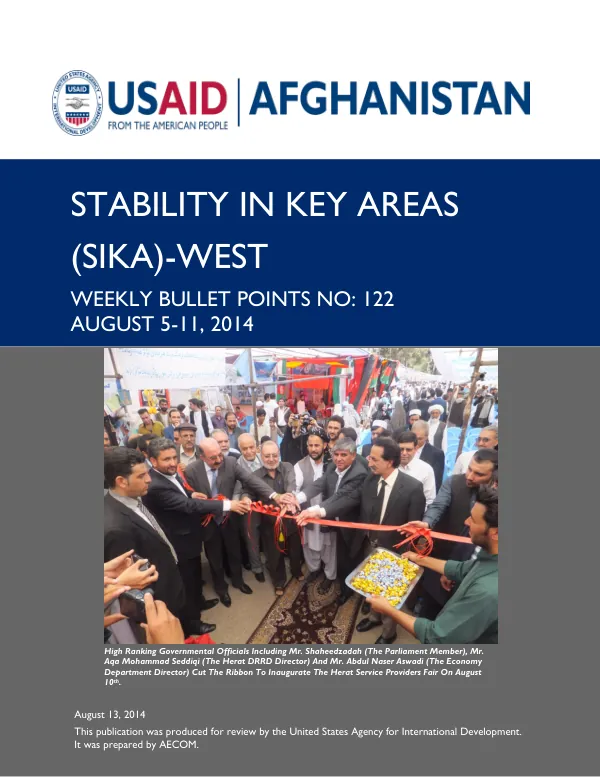
The program's primary objective is to promote stability and development in key areas, with a focus on disaster risk reduction, governance, and economic growth. A five-day Community Based Disaster Risk Reduction Management training was conducted for 40 GIRoA and SIKA-West staff from Bala Boluk, Pusht-e Rod, Lash Wa Juwayn, and Farah Center on August 9th. The training aimed to equip participants with the necessary skills to manage disaster risks and respond to emergencies. As part of the training, participants undertook a field visit to Gharie Karizak, a mountainous area regularly affected by heavy rainfall and floods. The Badghis DRRD established the Public Service Introduction Committee with participation of 18 governmental organizations on August 10th. The Committee is responsible for updating the Badghis Service Providers Catalog (SPC) every six months, distributing the SPC, and organizing the upcoming Service Providers Fair. The Committee's primary objective is to provide a platform for governmental and non-governmental organizations to directly communicate with the people, display their available services, and exchange contacts. The SIKA-West program has made significant progress in implementing projects across western Afghanistan. To date, 303 projects valued at $6,918,774 have been approved by MRRD and IDLG in target districts. Currently, CDCs are implementing 67 projects valued at $2,861,421. Additionally, 207 projects valued at $3,015,235 have been completed, and 29 projects valued at $1,585,359 are pending with the USAID Vetting Unit for action. The SIKA-West program has also been actively engaged in capacity building activities. A five-day Project Management training was started for 40 GIRoA staff in Badghis Province on August 9th. The training covered topics such as project leadership, types of projects, project cycle, project design, project planning, and monitoring and evaluation. The training was launched by Afghan Creative Consultancy Services. The Herat DRRD launched a two-day Service Providers Fair in Herat Province on August 10th, with the support of the USAID SIKA-West program. The Fair aimed to provide a platform for both governmental and non-governmental organizations to directly communicate with the people, display their available services, and exchange contacts. The Fair was attended by thousands of people, including local people, women, and school children, who acquired information about the available services. The SIKA-West program has also been actively engaged in monitoring activities. DRRD DSWs, SIKA-West engineers, and M&E personnel jointly conducted 36 project site visits. The CDCs implementing the projects were mentored on how to correct deficiencies noted, such as excavated drainages that were not according to engineering design. In Farah Province, stabilization practices training was provided to the Bala Boluk District Administrative Manager, Mr. Taimor Shah, on August 5th. The training aimed to equip the manager with the necessary skills to conduct the Komite Sobate Woleswali meeting. The meeting was successfully conducted on August 6th, with participants proposing several projects, including the rehabilitation of a 300m flood protection wall. In Badghis Province, Mr. Sharafuddin Majidi, the Badghis Provincial Government Office Manager, organized an inter-district Komite Sobate Woleswali meeting in Qala-i-Naw on August 6th. The meeting aimed to facilitate coordination and collaboration among the participants. A representative of the Community Cohesion Initiative (CCI) took part in the meeting, and a list of proposed projects not feasible for the SIKA-West to implement was shared with the CCI. The SIKA-West program has also been actively engaged in conflict resolution activities. The Bala Boluk Conflict Resolution Committee (CRC) resolved an inheritance dispute between two brothers on August 7th. The conflict started when the older brother claimed a larger share of the land. The CRC proposed an equitable distribution of the land between the two brothers, and the brothers accepted the proposal, ending their conflict. In Herat Province, the Kushk Rabat-e Sangi District Haj and Religious Affairs Manager, Mr. Abdul Ghani Jamshidi, was supported on preparing a guideline on how to rent government agricultural lands on August 6th. The guideline gives detailed information on the steps required to rent government agricultural lands.