AECOM INTERNATIONAL
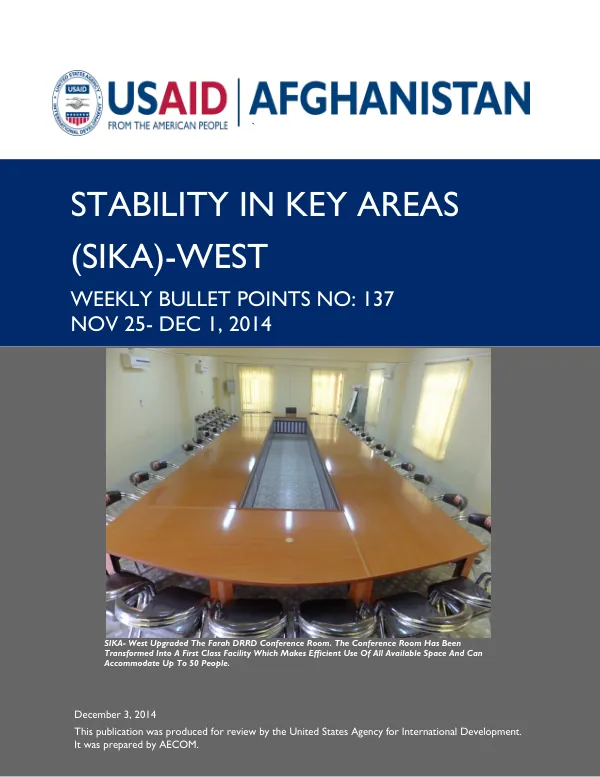
SIKA-West Weekly Bullet Points No. 137: Nov 25-Dec 1, 2014
The SIKA-West program in Afghanistan began in 2014 with the goal of improving service delivery and governance in the western provinces.
2014 · 4 pages
Sign in to readA free account is required to download.
Abstract
The program is implemented by AECOM and is funded by the United States Agency for International Development (USAID). The program focuses on three key areas: grants and subcontracts programming, cross-cutting capacity building, and monitoring activities. In the week of November 25-December 1, 2014, the SIKA-West program made significant progress in these areas. In terms of grants and subcontracts programming, 423 grant-funded projects valued at USD$9,512,518 were identified and approved by the Ministry of Rural Rehabilitation and Development (MRRD) and the Independent Directorate of Local Governance (IDLG) in the target districts. Of these projects, 148 were implemented by Community Development Councils (CDCs) and District Development Assemblies (DDAs), valued at USD$4,493,489. Additionally, 236 projects valued at USD$4,330,196 were completed, and four projects valued at USD$194,081 were pending with the vetting unit for action. In the area of cross-cutting capacity building, the SIKA-West program made significant progress in developing the capacity of local government officials and implementing partners. The Governance Department developed project cycle management, work plan development, and general administration training materials, which will be utilized and handed over to the IDLG SIKA Unit as reference material for future capacity building programming. The Communications and Public Outreach Department mentored the District Government Hotline focal points to record residents' complaints and share them with respective government departments for further action. The SIKA-West program also made significant progress in monitoring activities. As part of the USAID third-party verification, Checchi conducted a data quality assessment on two indicators: the number of projects completed with community and GIROA involvement and the number of local mechanisms supported with USG assistance for citizens to engage their sub-national government. The verification looked at how the data is being collected, analyzed, and reported as well as the integrity of the data. The Checchi indicated that SIKA-West has a proper mechanism in place and recommended sharing the system with other SIKAs. In addition to these achievements, the SIKA-West program also made progress in the provinces of Farah, Badghis, Herat, and Ghor. In Farah Province, the Communications and Public Outreach Department supported the Bala Boluk Youth Association in sharing their concerns with the Provincial Education and Health Departments. The Education and Health Departments pledged to follow up these issues and provide the required school equipment and health facilities. In Badghis Province, the Qadis and Muqur District Government personnel held project completion ceremonies for three recently completed projects that improved rural road network access for up to 1470 people to the District Centers. In Herat Province, the Admin and Finance Manager and the District Mayor visited the Kushk Rabat Sangi Bazar and directly communicated with shopkeepers to listen to their concerns. In Ghor Province, the Chaghcharan Education Directorate celebrated the International Day of Children in Sultan Ghiasuddin Boys' High School, and the Qouch CDC completed 73% of a four-slab culverts construction project in Qouch Village, Lash Wa Juwayn District, expected to improve access for 1500 people to the District Center. Overall, the SIKA-West program made significant progress in improving service delivery and governance in the western provinces of Afghanistan during the week of November 25-December 1, 2014.
Related documents