AECOM INTERNATIONAL
SIKA-West Weekly Bullet Points No. 140: Dec 16-22, 2014
Stability in Key Areas (SIKA)-West is a program aimed at promoting stability and development in western Afghanistan.
2014 · 4 pages
Sign in to readA free account is required to download.
Abstract
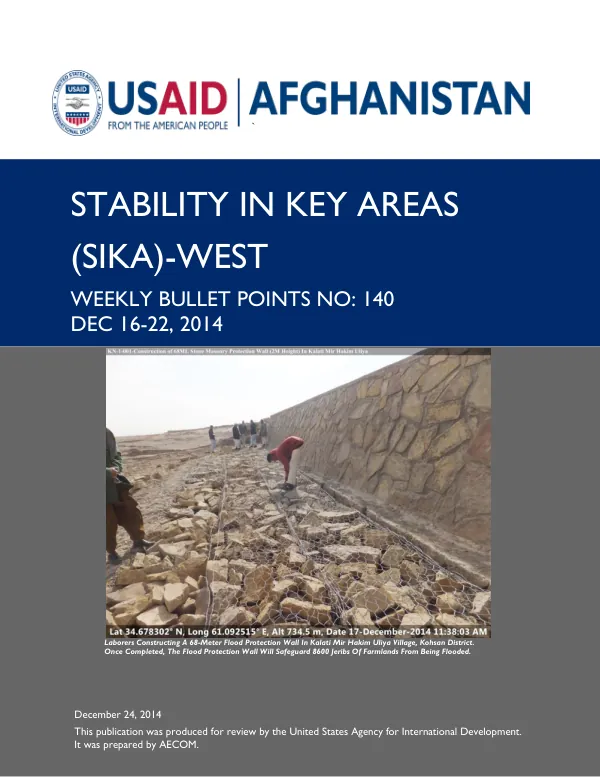
The program is implemented by the Ministry of Rural Rehabilitation and Development (MRRD) and the Independent Directorate of Local Governance (IDLG) in collaboration with the United States Agency for International Development (USAID). The SIKA-West program focuses on several key areas, including grants and subcontracts programming, cross-cutting capacity building, and monitoring activities. In the area of grants and subcontracts programming, the program has identified and approved 437 grant-funded projects valued at USD$9,839,763 in the target districts. These projects are being implemented by Community Development Councils (CDCs) and District Development Assemblies (DDAs), with a total value of USD$4,520,557. The SIKA-West program has also made significant progress in cross-cutting capacity building. Training sessions were conducted for CDC members, government staff, and community residents on various topics, including project management, procurement processes, community mobilization, and effective communication. These training sessions aimed to improve the capacity of government staff and community residents to implement projects and advocate for residents' concerns. In terms of monitoring activities, the SIKA-West program has conducted joint project site visits with government officials, engineers, and monitoring and evaluation personnel. These visits have identified deficiencies that need to be corrected, and the program has advised implementing CDCs to address these issues before the next milestone payment is authorized. The SIKA-West program has also made progress in Farah Province, where female members of the Lash Wa Juwayn Komite Sobate Woleswali discussed their community problems, including poor educational facilities, lack of potable water, and bad road conditions. The district government agreed to address these conditions by providing school equipment, rehabilitating the road, and supplying water. In Badghis Province, the Communications and Public Outreach Department conducted a training session on the Service Providers Catalogue (SPC) usage for 24 Boyaha CDC members. The participants will use the Badghis SPC to find potential third-party donors to address their community major problems. In Herat Province, the Kohsan District Executive Manager visited the work progress of a 2-KM road rehabilitation project in Islam Qala Shamali village. The DEM was pleased with the work quality and asked the implementing CDC and community residents to pay attention to the project maintenance. Once completed, the rehabilitated road will improve access for 450 families to the District Center. The SIKA-West program has also made progress in Ghor Province, where the "Administrative and Management" training course for female government staff and recent university graduates is ongoing. The participants have learned time management skills and how to produce documents using Microsoft Word. The program has also reported progress in various districts, including the completion of 90% work on a 1.9-KM road rehabilitation project in Farah Center, a 50-meter flood protection wall construction project in Lash Wa Juwayn, and a 47-meter flood protection wall construction project in Qala-i-Naw. These projects are expected to improve access for residents and safeguard farmlands from flooding. However, the program has faced challenges due to cold weather, which has affected project implementation. The security situation has also improved in Shindand District following the Afghan National Police operation, and all program activities have been resumed effective December 24th.