RAND CORP.
SIZE AND AGE STRUCTURE OF FAMILY HOUSEHOLDS, EXPLORATORY COMPARISONS
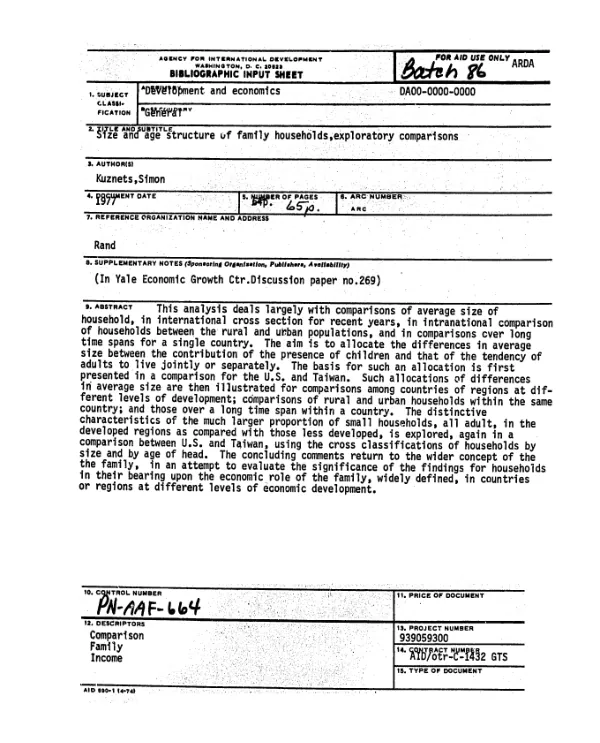
This analysis deals largely with comparisons of the average size of household, in international cross section for recent years, in intranational comparisons of households between the rural and urban populations, and in comparisons over long time spans for a single country.
KUZNETS, SIMON · 1970
Sign in to readA free account is required to download.
Abstract
The aim is to allocate the differences in average size between the contribution of the presence of children and that of the tendency of adults to live jointly or separately. The basis for such an allocation is first presented in a comparison for the U.S. and Taiwan. Such allocations of differences in average size are then illustrated for comparisons among countries of regions at different levels of development; comparisons of rural and urban households within the same country; and those over a long time span within a country. The distinctive characteristics of the much larger proportion of small households, all adult, in the developed regions as compared with those less developed, is explored, again in a comparison between U.S. and Taiwan, using the cross classifications of households by size and by age of head. The concluding comments return to the wider concept of the family, in an attempt to evaluate the significance of the findings for households in their bearing upon the economic role of the family, widely defined, in countries or regions at different levels of economic development.
Connected topics