MOHAMMED V UNIVERSITY
Sizing Prenatal mPHRs using COSMIC Measurement Method
Mobile Personal Health Records (mPHRs) apps for prenatal monitoring are mobile health applications designed to track pregnancy.
2019 · 11 pages
Sign in to readA free account is required to download.
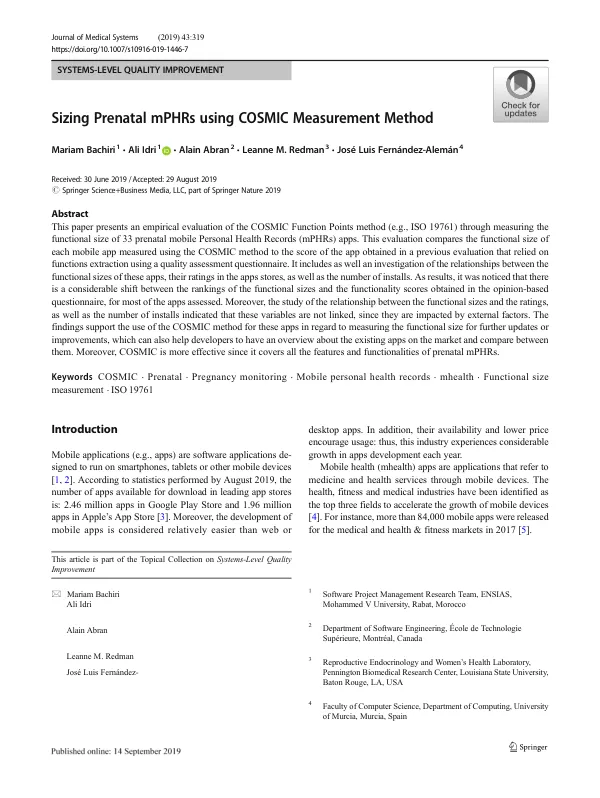
Abstract
These apps are dedicated to pregnant women, allowing them to monitor their health and the health of their baby. The apps provide various functionalities, including tracking weight and blood pressure, providing guides for nutrition and physical exercises, recording baby movements and contractions, and following the progress of pregnancy during all its stages. The COSMIC Function Points method is a functional size measurement (FSM) method used to quantify the functional size of software. This method is applicable to business, real-time, and infrastructure software, and it complies with the standard ISO/IEC 14143/1. The COSMIC method has several assets, including being publicly available and applicable to a wide range of software. It is also compatible with modern concepts of software engineering. A previous study used the COSMIC method to measure the functional size of 17 free pregnancy monitoring mPHRs. The study compared the COSMIC functional size values with those obtained using a qualitative questionnaire. The aim of this comparison was to empirically apply the COSMIC method on mPHRs for pregnancy monitoring, in order to identify its accuracy in measuring the functional size of these apps compared to a qualitative method. The present study extends the previous study by updating the set of mPHRs with a selection of 33 free prenatal mPHRs apps available in Apple App store and Google Play store. The study investigates two other research questions to study the relationships between the COSMIC functional size values, of the selected prenatal mPHRs, and the ratings of users in the apps stores, in addition to their number of installs. The study compares the COSMIC functional sizes of the 33 selected prenatal mPHRs with functionality scores obtained by using the questionnaire-based evaluation, users' ratings in app stores, and numbers of installs. The COSMIC method is used to measure the functional size of software by quantifying the functional user requirements. The method is based on fundamental principles of software engineering and metrology. It is applicable to a wide range of software, including business, real-time, and infrastructure software. The COSMIC method has several assets, including being publicly available and compatible with modern concepts of software engineering. The study aims to answer three research questions: RQ1, RQ2, and RQ3. RQ1 investigates whether the standard-based COSMIC functional size provides a functional ranking of prenatal mPHRs similar to the functional ranking using the opinion-based questionnaire. RQ2 examines the relationship between the COSMIC functional size of prenatal mPHRs and their users' ratings in the app stores. RQ3 investigates whether a high COSMIC functional size implies a higher number of installs of the 33 selected prenatal mPHRs. The study uses a descriptive research design, where the COSMIC method is applied to measure the functional size of 33 prenatal mPHRs apps. The study collects data on the COSMIC functional size values, users' ratings in app stores, and numbers of installs. The study analyzes the data to answer the research questions and to identify the relationships between the COSMIC functional size values and the ratings of users in the apps stores, in addition to their number of installs. The study contributes to the existing body of knowledge by providing an empirical evaluation of the COSMIC method on prenatal mPHRs apps. The study highlights the importance of using a standardized method to measure the functional size of software, particularly in the context of mPHRs apps. The study also provides insights into the relationships between the COSMIC functional size values and the ratings of users in the apps stores, in addition to their number of installs.