USAID. MISSION TO BURUNDI
Small farming systems research
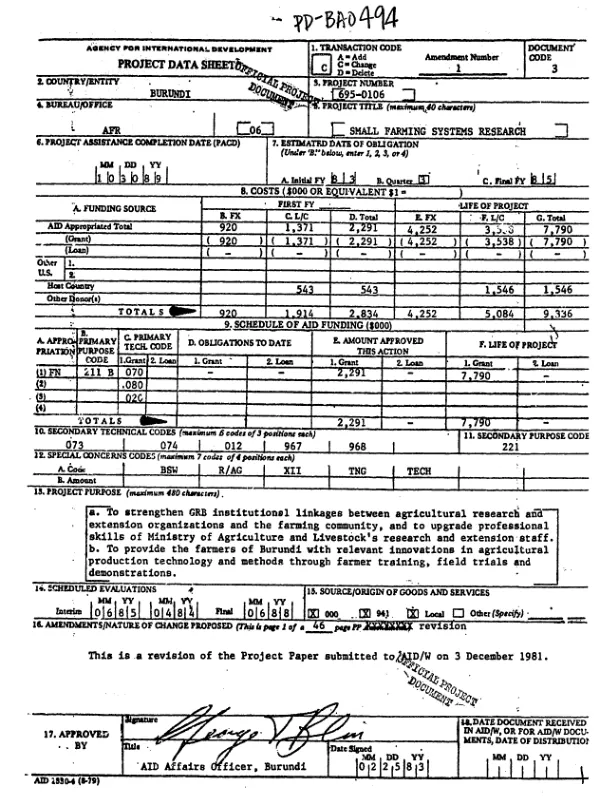
Project to improve small farm production of basic food crops in Burundi by strengthening the farming systems research and extension (FSR&E) capabilities of the Ministry of Agriculture and Livestock (MOAL) and linkages among the two MOAL implementing agencies, L"Institut des Sciences Agronomiques du Burundi (ISABU) and the Department of Agronomy (DOA), and farmers.
1983
Sign in to readA free account is required to download.
Abstract
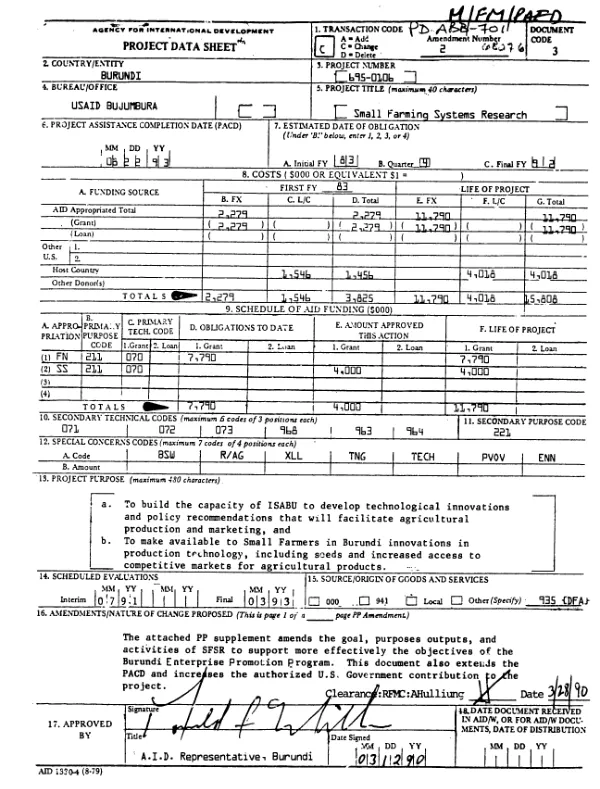
A U.S. Land Grant university will help with implementation. To strengthen the MOAL"s FSR&E capabilities, the project will provide U.S. and African M.Sc. training to 2 engineer-agronomist technicians, 2 University of Burundi (UB) graduates in economics, and 3 UB graduates in science. Medium-term, nondegree training will be given to 3 engineer-technicians, one UB graduate in economics, and 5 postsecondary-leevel technicians. The project will also provide short-term (3-6 month) FSR training at international research centers to 9 MOAL technicians and short-term, inservice training for research assistants, extensionists (a total of 240 at all levels) and data collection personnel. Participating farmers will receive 1-day sessions in new cultural practices and crop varieties. To strengthen research-extension linkages, ISABU will establish an FSR&E Department which will in turn establish Adaptive Research Teams - composed of both ISABU and DOA personnel - to conduct on-farm and on-station research in basic food crop varieties and related soil fertility and soil and water conservation problems in Mutaho and Bugenyuzi, two ecologically significant communes in Burundi"s central plateau. Technologies that successfully address these problems will be disseminated widely by the MOAL"s extension service. Specific outputs include producing and distributing improved seed and establishing a replicable methodology for collecting farm-level FSR data. The project, which will be coordinated with Project 6950101, is the beginning of a 10-15 year effort to bring concerned Burundi institutions to full maturity. Amendment of 3/12/90 modifies the project"s goal, purposes, outputs, and activities in a way supportive of the Burundi Enterprise Promotion Program (6950125), a new policy-based assistance program that will provide the central theme for USAID/B"s portfolio. Major changes are as follows. (1) The FSR component will be rewrought to support two ISABU regional research workshops, called "ateliers," each comprised of a research team that conducts trials on actual farms. (2) Two components will be added. The first, Marketing Support and Analysis, will enhance ISABU"s abilty to contribute to policy dialogue on market reforms, food pricing, rural infrastructure policies, etc. The second, Private Sector Seed Development, will strengthen the GRB"s recently formed National Seed Commission and establish two other new organizations -- the National Seed Service and the National Seed Society -- in order to eventually move responsiblility for seed production and marketing to the private sector. TA and training (including M.S. training) are provided for both new components. The project will also now include an activity to support the Regional Potato Improvement Program for Central Africa. PACD is extended 23 months to 8/93. (PD-ABB-701)
Related documents