ACADEMY FOR EDUCATIONAL DEVELOPMENT, INC. (AED)
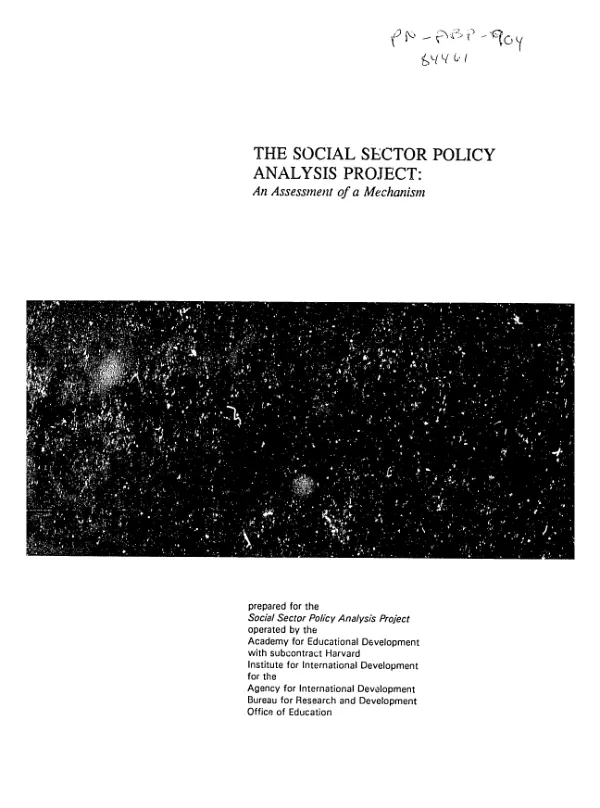
Social sector policy analysis project : an assessment of a mechanism
Assesses the Social Sector Policy Analysis (SSPA) project (1989-92) as a mechanism for supporting the development of A.I.D.
Rauner, Mary · 1993
Sign in to readA free account is required to download.
Abstract
social science policies. The SSPA project supported policy development by the Office of Policy Development and Program Review (PDPR) of A.I.D."s Program and Policy Coordination Bureau. Before the SSPA project, PDPR had been heavily dependent on external contractors and grantees to complete small tasks, and was required to execute a contract or grant for each task. To increase PDPR"s efficiency, the SSPA project instead used a cost contract mechanism. This report compares this cost contract mechanism to, primarily, the in-house and IQC mechanisms, for the 28 tasks completed under the project. For most factors, the SSPA mechanism was found to be the most effective. The mechanism is flexible enough to be used on cross-sectoral tasks, and to accommodate tasks with multiple components. Other benefits of the mechanism are its responsiveness, cost-effectiveness, quick start-up time, and contractual simplicity. It also offers: input from all parties (A.I.D. staff, contractor staff, and consultants) into scopes of work; high quality consultants; choice of consultants; minimal fiscal risk (modest total annual cost); external input which places A.I.D. in a proactive rather than a reactive position; and cross-sectoral discussion. Some shortcomings of the SSPA mechanism include: lack of formal accountability of the project manager, which may leave the project open to both internal and external criticism; a lack of flexibility in daily payment of consultants, e.g., conference or seminar presenters; the potential high costs of collaboration among offices; the inexperience of A.I.D. staff in working with a project of this nature; and the potential that topic selection could be politically driven. The following recommendations are made. (1) Additional projects utilizing this mechanism should be developed. It has proven a fast, flexible, and effective vehicle for serving the research, policy support, and dissemination needs of the Agency. (2) Such a project would be well placed in most centralized offices, although it would also be successful in regional or sectoral offices where technical staff are present. (3) A project of this nature should have few restrictions in terms of scope, in order to maintain flexibility and responsiveness; however, an advisory group should be established and an informal evaluation system built into the project. (4) If the project is designed to be accessible throughout the Agency, it must be marketed. (5) A project utilizing this mechanism would be most effective for numerous modestly funded tasks.
![Contraceptive security in Nicaragua : assessing strengths and weaknesses -- February 2-13, 2004 [: summary]](https://covers.devme.ai/gen/28676.webp)
![AID"s role in Central America : overview [and country programs]](https://covers.devme.ai/gen/36625.webp)
![Contraceptive security in Honduras : assessing strengths and weaknesses -- April 26-May 7, 2004 [: summary]](https://covers.devme.ai/gen/28677.webp)