USAID DEC
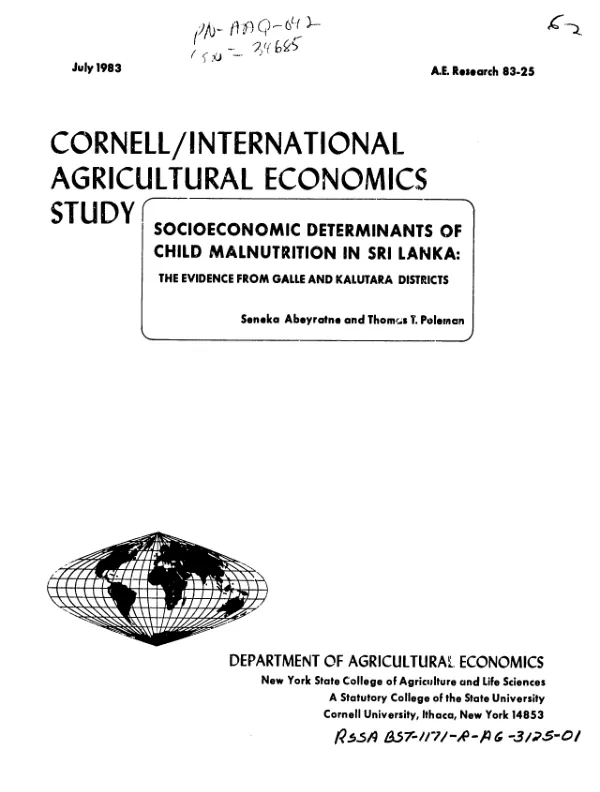
Socioeconomic determinants of child malnutrition in Sri Lanka : the evidence from Galle and Kalutara districts
Sign inCORNELL UNIVERSITY. NEW YORK STATE COLLEGE OF AGRICULTURE AND LIFE SCIENCES. DEPT. OF AGRICULTURAL ECONOMICS
Socioeconomic determinants of child malnutrition in Sri Lanka : the evidence from Galle and Kalutara districts
To identify socioeconomic determinants of malnutrition in Sri Lanka, dietary, socioeconomic, and anthropometric data (the latter for preschool children only) were obtained during a survey of 1,000 rural households with at least one preschool child in Sri Lanka"s Galle and Kalutara Districts.
Abeyratne, Seneka; Poleman, Thomas T. · 1983
Sign in to readA free account is required to download.
Abstract
The findings suggest that previous anthropometric studies have overestimated the extent of protein-calorie malnutrition (PEM), due mainly to overly rigid interpretation of rather arbitrary criteria - very slight changes in the criteria for assessing PEM can lead to dramatically differing conclusions. Key findings are: (1) the majority of PEM cases are moderate and only a minute fraction severe; (2) PEM is highest among unemployed and landless households, lowest among farmers and mixed on-farm/off-farm income earners; (3) children experience sudden deterioration in nutritional status during weaning; and (4) preschool children are as vulnerable as are pregnant and lactating women to second and third degree PEM. The author concludes that child malnutrition in Sri Lanka could be eliminated quickly and with minimal expense through oral rehydration therapy and the provision of Thriposha (a nutritious weaning food).
Connected topics
![Nutrition and health status of young children and their mothers in Eritrea : findings from the 1995/96 Eritrea demographic and health survey [DHS]](https://covers.devme.ai/gen/32556.webp)
![Nutrition and health status of young children and their mothers in Mali : findings from the 1995/96 Mali demographic and health survey [DHS]](https://covers.devme.ai/gen/45157.webp)